
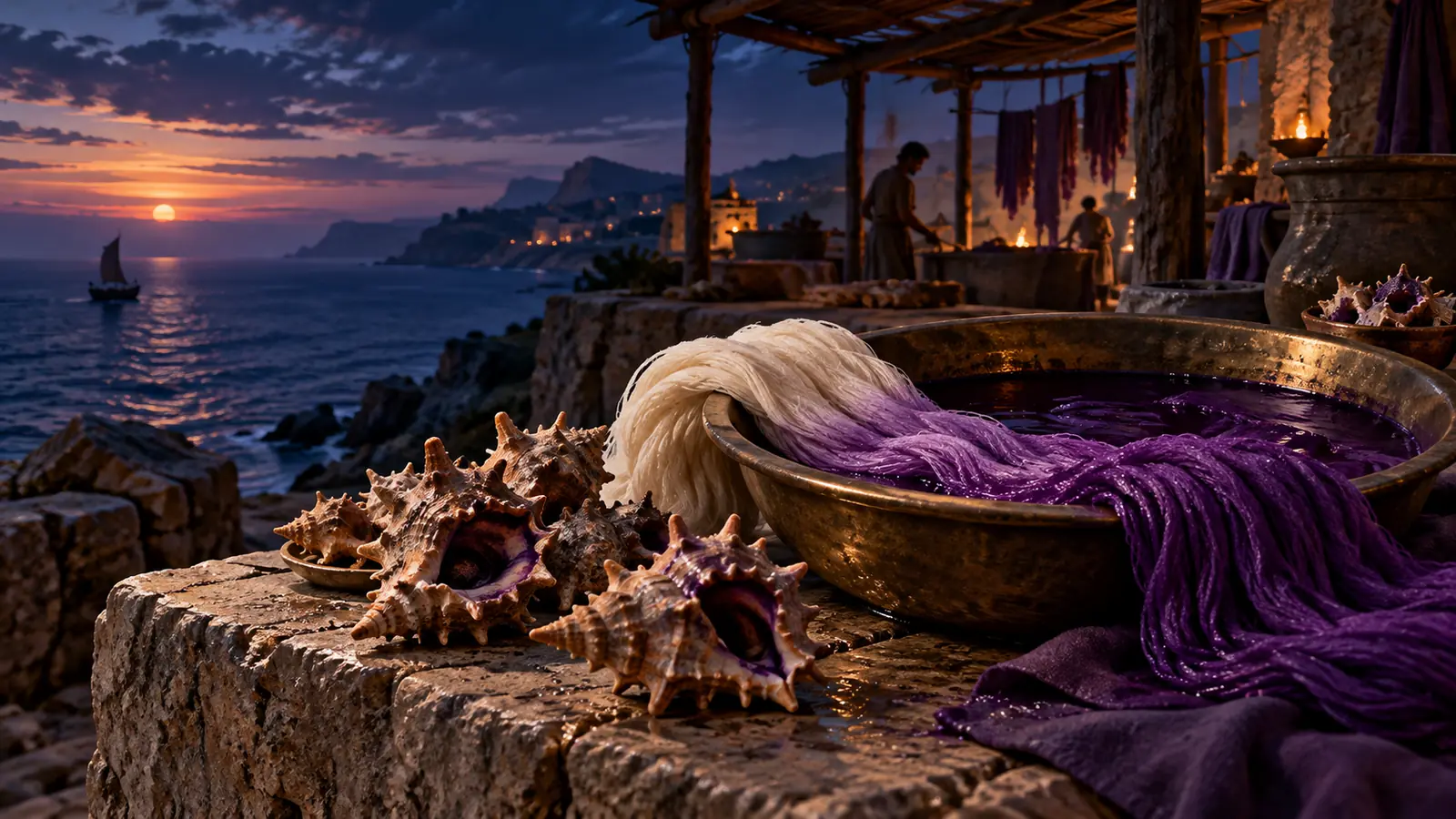
Ancient purple did not begin in a paint pot. It began as a pale secretion inside Mediterranean sea snails—and became a technology of wealth and rank. [1]
A color built from scarcity
Tyrian purple came from mucus glands of three marine snail species. Extracting it was slow, labor-intensive and guarded knowledge. A Smithsonian museum researcher notes an estimate of about 10,000 snails for one gram of pigment. The resulting dye resisted fading, so scarcity was woven into something that could endure. [1]
Older than the Phoenician brand
The technique long predates Rome. Archaeological evidence summarized by the Met places murex-purple production on Minoan Crete by about 2000 BCE. Later, Phoenician cities such as Tyre, Sidon, Byblos and Arwad became famous maritime traders in the dye; even the Greek-derived name “Phoenician” may be connected to a word for purple-red. [2][3]
What to keep in mind
Exact recipes, yields and shades varied by species and workshop. The estimate of 10,000 snails per gram illustrates scarcity; it should not be treated as a universal production ratio for every place or period. [1]
Sources & context
Numbered references link the explanation to its sources. Hypothetical examples and visual metaphors are labelled in the text. Checked 13 October 2026.
- Smithsonian National Museum of Natural History — The History of the World in Seven Snails (29 May 2025)
- The Metropolitan Museum of Art — The Phoenicians (1500–300 B.C.)
- The Metropolitan Museum of Art — Terracotta stemmed cup with murex decoration
KEEP EXPLORING
 Twenty Coins Bring Rome’s English Quarter Into ViewNewsroom · 3 min read
 Why Is the Old City Below the New One?Peek · 2 min read
 Why AI Progress Now Happens Between Your QuestionsExplore · 5 min read
CURIOUS MINDS, SHARED IDEAS
Join the conversation
What surprised you? Share a thought or a question.
Loading reader responses…