
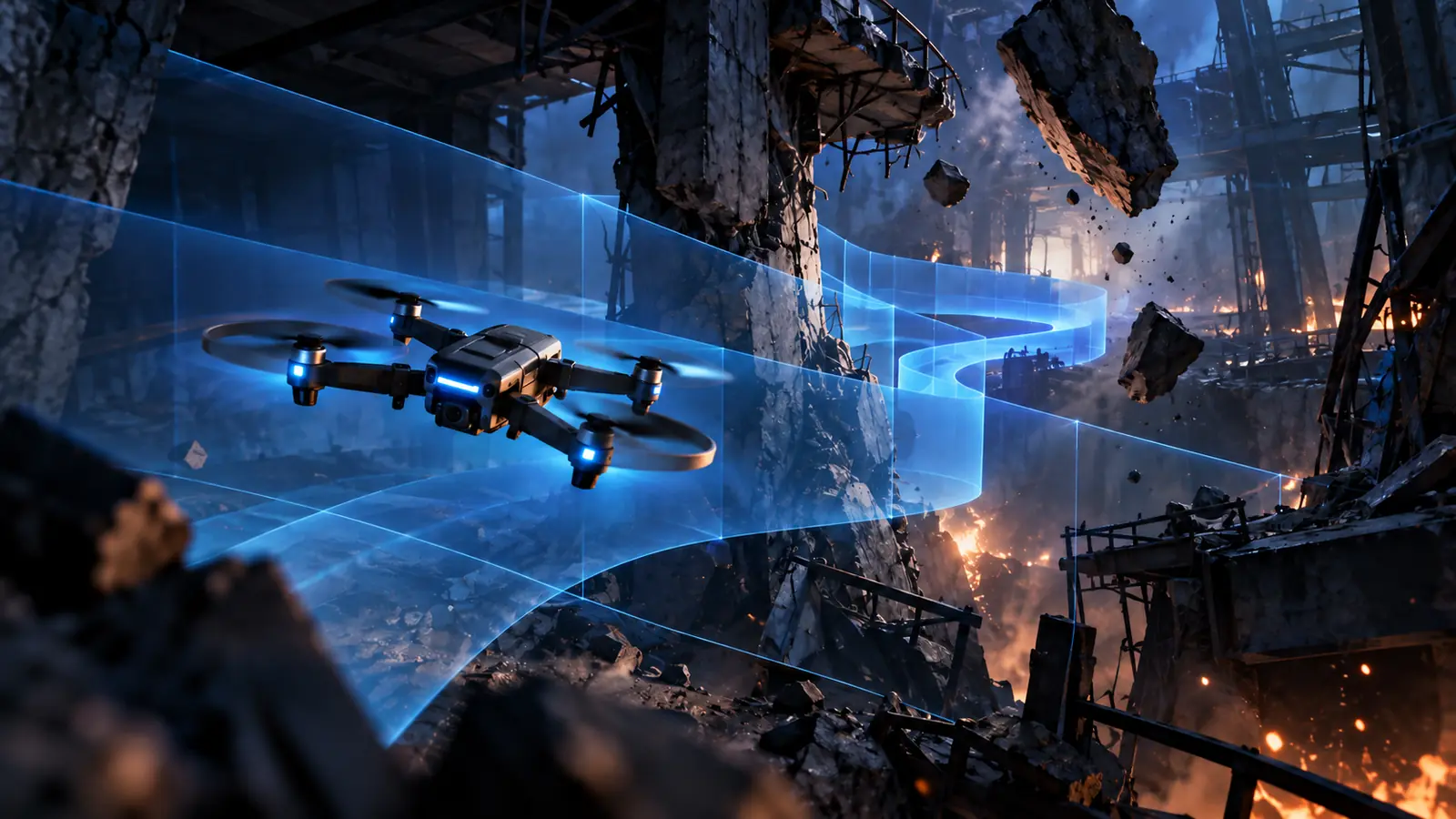
A route can become dangerous after a drone starts moving. SANDO replans around obstacles it did not know existed—including objects that keep moving. [1][2]
A corridor that moves with danger
MIT announced the system on 7 October 2026. Instead of predicting one exact future for an obstacle, SANDO uses bounds on its speed, size and sensing error to construct a time-varying safe corridor. The drone then repeatedly optimizes a path inside it. [1][2]
Tested in simulation and flight
The peer-reviewed paper appears in IEEE Transactions on Robotics. In simulations, SANDO completed all reported forest and dynamic benchmark levels without constraint violations. The team also demonstrated fully onboard planning in six static and twelve dynamic-obstacle flights. [2][3]
What to keep in mind
This is not a guarantee against every real hazard. Safety depends on stated bounds for obstacle motion, size and perception error; the hardware demonstrations were limited, and the researchers still want greater computational efficiency. [1][2]
Sources & context
Numbered references link the explanation to its sources. Hypothetical examples and visual metaphors are labelled in the text. Checked 14 October 2026.
- MIT News — Planning system ensures a robot’s flight path will remain collision-free (7 October 2026)
- Kondo et al. — SANDO: Safe Autonomous Trajectory Planning for Dynamic Unknown Environments, open author manuscript v3 (25 September 2026)
- Comillas Pontifical University, IIT — SANDO publication record, IEEE Transactions on Robotics, in press September 2026
KEEP EXPLORING
 Can an AI Explore Freely and Still Obey a Hard Rule?Explore · 3 min read
 A Robot Can Do the Task. Can It Do the Job?Newsroom · 3 min read
 A Medieval Skeleton Cannot Tell Us Which Side He TookPeek · 1 min read
CURIOUS MINDS, SHARED IDEAS
Join the conversation
What surprised you? Share a thought or a question.
Loading reader responses…