
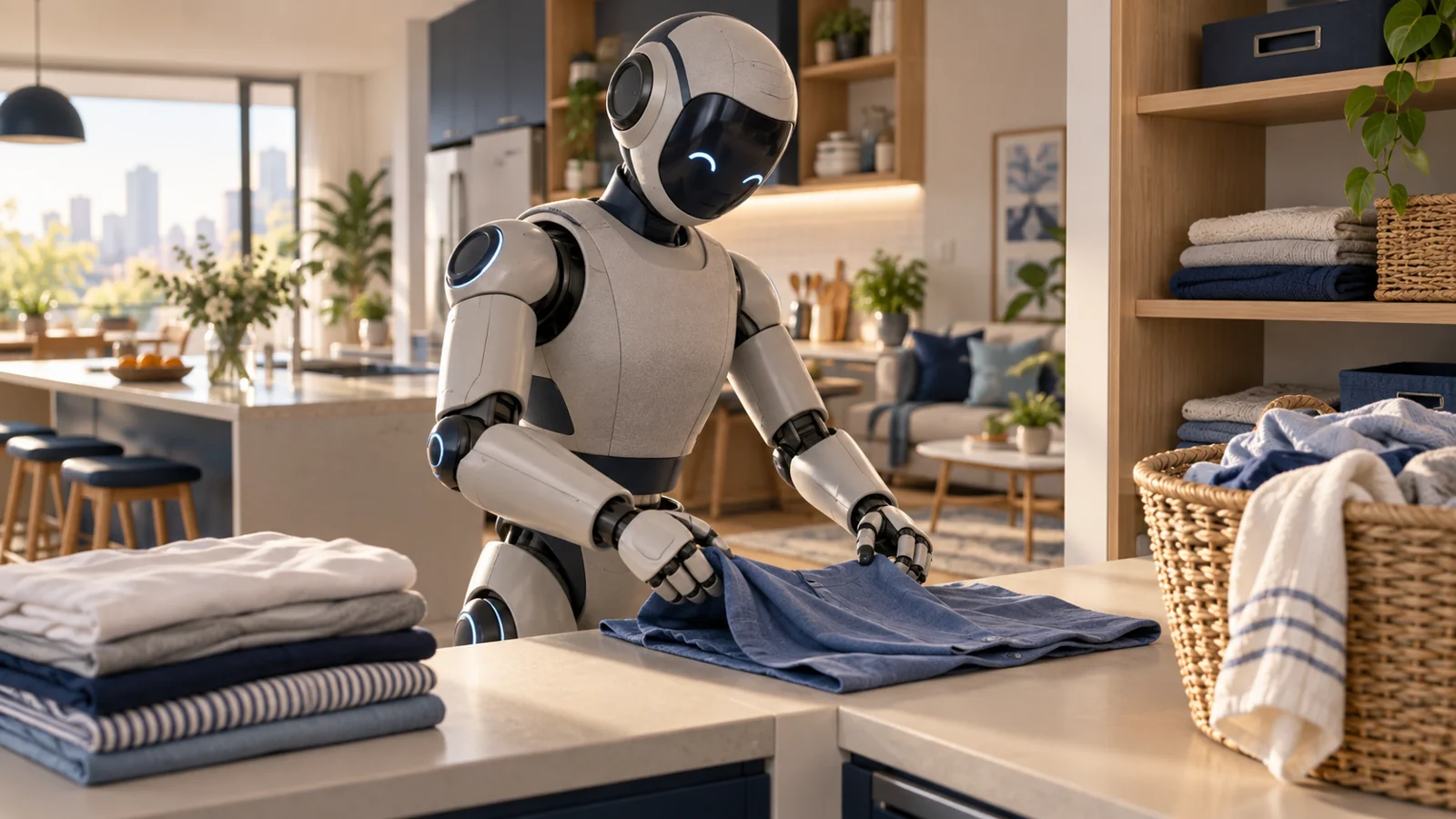
The washing is finished. Somebody still has to empty the machine, separate the items, dry them, fold them and put them where they belong. A robot folding a towel is an intriguing beginning. The real prize is getting to the end of that ordinary sentence.
A home is a moving target
AI & Robots makes an important distinction in its chapters on robot learning and living with robots: a demonstrated skill is not the same thing as dependable help throughout a home. Sensors, movement, handling and recovery must work together. A robot also needs to recognise when it should ask for help. [1]
Imagine telling a helper to tidy the kitchen. You may mean clearing dishes, keeping a half-finished drink, avoiding a fragile ornament and leaving somebody's homework alone. A home contains objects with different meanings as well as different shapes. The instruction sounds short because people fill in so much unwritten context.
The useful test is therefore not merely whether a machine can move a cup. Can it complete the intended routine, notice an exception and leave the room in a state you actually wanted?
What the demonstrations really show
On 27 January 2026, Figure presented Helix 02 with a continuous kitchen demonstration. According to Figure, its robot walked, unloaded and reloaded a dishwasher and handled objects across the room during a four-minute autonomous task, without human intervention. The company describes integrating whole-body movement with manipulation. These are producer-reported demonstration conditions, not an independent trial in many households. [2]
Figure's August 2025 laundry demonstration was more specific than the phrase 'does the laundry' suggests: it showed autonomous towel folding. The company described selecting towels from a pile, changing a folding approach and recovering from picking up extra items. That is useful evidence about handling flexible fabric, not evidence of an entire wash-to-wardrobe service. [3]
In May 2026, Figure showed two humanoids tidying a bedroom and making a bed together. The reported sequence included hanging clothing, putting away headphones, handling a book and disposing of rubbish. A growing set of household actions is becoming visible, but the scope of each demonstration still matters. [4]
Follow the laundry all the way home
Picture the full routine: collect clothing, identify what needs separate treatment, load the washer, choose an appropriate programme, handle drying, fold or hang each item, then put it in the correct place. This is an illustrative task breakdown, not a capability list for a robot currently on sale.
Towels are a useful starting point because fabric moves as it is handled. Figure explains that cloth lacks a fixed shape and can bunch, slip or tangle. A system must adjust while acting rather than simply repeat a memorised grasp. [3]
But even good handling leaves household questions unanswered. Where do the children's clothes belong? Is an item supposed to hang rather than fold? Has somebody moved the basket? What happens when a door will not open? These hypothetical exceptions explain why completing a routine requires more than adding up impressive individual skills.
A convincing whole-routine test would show the final state and the interventions along the way. It would let a viewer see whether the machine needed a person to reset an object, clear its path or choose the next step.
Laundry is a routine, not one movement
- 01Collect and sort
Find the clothing and identify items needing separate treatment.
- 02Wash and dry
Load the machine, choose the programme and handle drying.
- 03Fold or hang
Different fabrics and garments need different handling.
- 04Put everything away
Return each item to the right place, and handle interruptions along the way.
Cooking, cleaning and all the tempting possibilities
A future helper could reduce effort by carrying groceries, retrieving ingredients, setting a table, clearing dishes, wiping suitable surfaces, moving washing and returning objects to shelves. Those are ambitions and possible uses. They should not be read as verified capabilities of every home robot.
Cooking raises a particularly revealing difference. Fetching a container or moving a bowl can be one step in meal preparation. Preparing a complete meal also requires an appropriate sequence, handling ingredients, using equipment and recognising when the result is ready. In an imagined kitchen, hot cookware, a spill or somebody walking into the workspace changes what a safe next action would be.
The demonstrations cited here do not establish dependable autonomous meal preparation, general house cleaning or full household laundry. Showing a robot near a cooker would not establish those abilities either.
For each enticing claim, ask for the specific action, the conditions and the role of any person assisting. A description that names those limits can be more useful than a video that makes every chore appear equally solved.
A person may still be part of the product
1X's NEO order page states that US deliveries start in 2026. It describes basic autonomy for early owners and scheduled expert assistance for unfamiliar complex tasks. A 1X expert can remotely supervise the robot's actions. The delivery statement is the company's advertised timetable, not independent confirmation of widespread household deployment. [5]
That detail changes what it means to buy a helper. Autonomous action, remote guidance and direct remote control are different modes. When assessing a product, ask which mode applies to the task you care about, who can access the system and how that access is authorised.
The book places privacy and support alongside physical capability for good reason. A camera in a household workspace and a person helping from elsewhere belong in the same conversation as dexterity. Ask how private areas, visitors and interruptions are handled, rather than assuming a friendly body shape answers those questions. [1]
The first useful robot need not do everything
Consider three imagined households. One mainly needs help moving objects that are difficult to carry. Another wants dishes cleared every evening. A third needs the laundry completed with very few interventions. The same machine could be valuable to one and disappointing to another.
This suggests a practical way to judge progress: specify the routine, watch it happen and count the occasions when somebody must take over. Also ask what the robot does when it cannot finish. Stopping and asking may be a better outcome than continuing incorrectly.
The progress in the cited demonstrations is meaningful because the actions are ordinary and recognisable. They show parts of the route from a laboratory skill to household usefulness. The next milestone is a routine that still works when objects move and daily life interrupts it.
We do not need to know the exact year a universal housekeeper arrives to understand that change. A reliable helper for a limited set of burdens could already matter. Its value would come from effort actually saved, not the number of chores pictured in an advertisement.
What to keep in mind
Capability examples are manufacturer demonstrations, not independent evidence of reliable operation across ordinary homes. 1X's delivery timing and assistance model are its published product statements checked in October 2026. Full cooking, cleaning and wash-to-wardrobe scenarios are ambitions, not verified capabilities of the products discussed.
Sources & context
Numbered references link the explanation to its sources. Hypothetical examples and visual metaphors are labelled in the text. Checked 3 October 2026.
- AhaPeek: AI & Robots — robot learning and living-with-robots chapters
- Figure: Introducing Helix 02 (27 January 2026)
- Figure: Helix Learns to Fold Laundry (12 August 2025)
- Figure: Helix 02 Bedroom Tidy (8 May 2026)
- 1X: NEO order page and assistance model
KEEP EXPLORING
 From Chatbots to AI AgentsExplore · 3 min read
 When Does a Chatbot Become an Agent?Peek · 2 min read
 A Robot Can Do the Task. Can It Do the Job?Newsroom · 3 min read
CURIOUS MINDS, SHARED IDEAS
Join the conversation
What surprised you? Share a thought or a question.
Loading reader responses…