
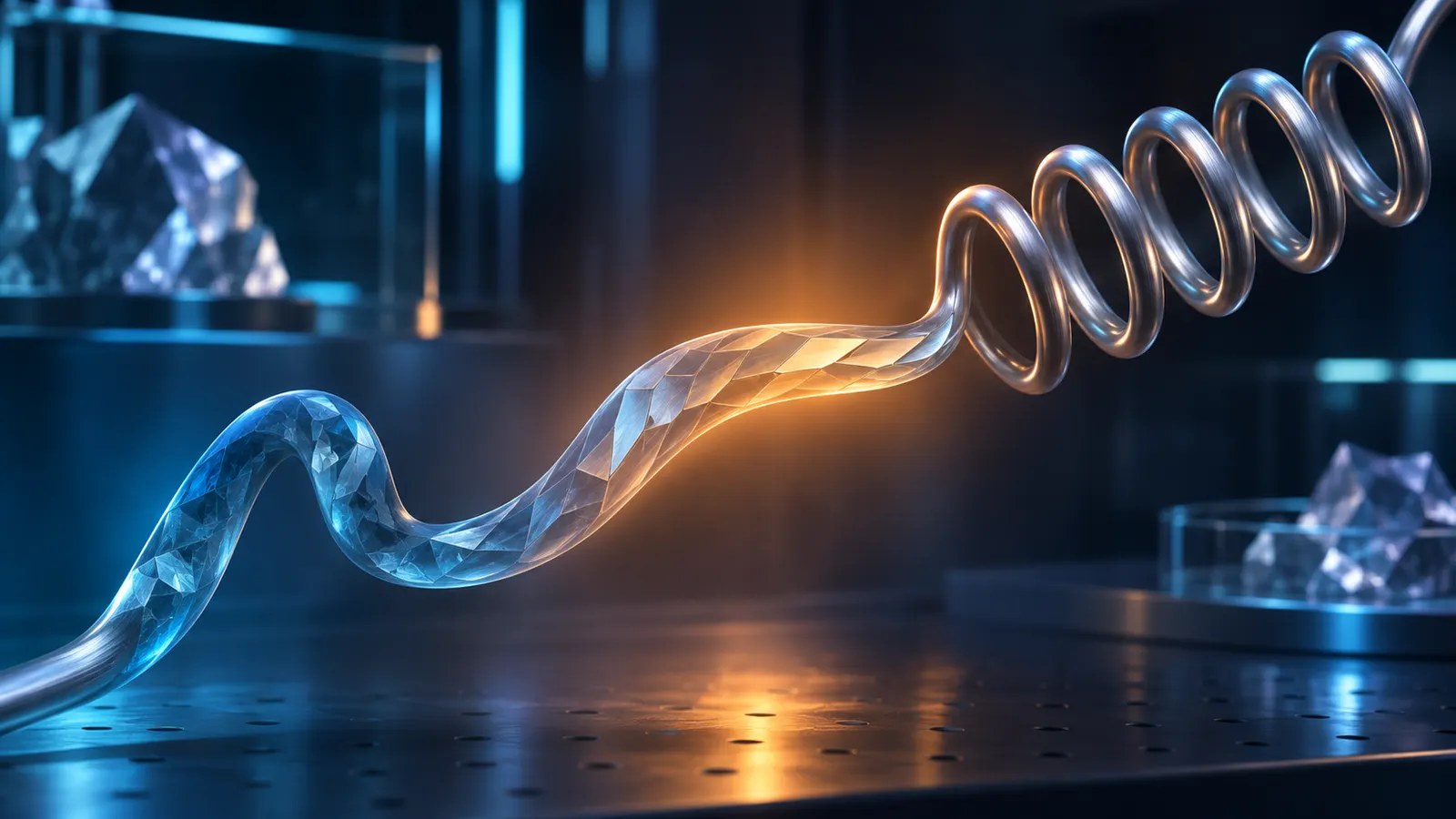
Bend a piece of nitinol while it is cool, then heat it, and it can pull itself back toward a preset form. The metal is not remembering like a brain; its crystal structure is switching states.
Two solid phases
Nitinol, a nickel–titanium alloy, can exist as low-temperature martensite and high-temperature austenite. In martensite, variants of the crystal structure can reorient when the wire is bent. Heating through the designed transformation range converts the material back to austenite, whose ordered structure corresponds to the preset geometry, so much of the deformation disappears [1][2]. Nothing melts: this is a reversible solid-to-solid phase transformation.
Heat becomes motion
That motion can turn temperature into mechanical action without a motor. Shape-memory alloys already appear in connectors, couplings, valves, actuators and medical devices; nitinol wire is also used in orthodontics [1][2]. Engineers can adjust transformation temperatures through composition and processing, matching the response to a particular job.
What to keep in mind
Limits: Recovery works only within designed transformation and strain ranges. Excessive deformation can become plastic and permanent, and Penn State notes that nitinol remains too expensive for many large-scale uses.
Sources & context
Numbered references link the explanation to its sources. Hypothetical examples and visual metaphors are labelled in the text. Checked 17 November 2026.
- [1] NASA — Shape Memory Alloys: A Complete Guide
- [2] Penn State Center for Nanoscale Science — Nitinol
KEEP EXPLORING
 When Waste Plastic Becomes a Structural ShapePeek · 1 min read
 Why AI Progress Now Happens Between Your QuestionsExplore · 5 min read
 A Robot Can Do the Task. Can It Do the Job?Newsroom · 3 min read
CURIOUS MINDS, SHARED IDEAS
Join the conversation
What surprised you? Share a thought or a question.
Loading reader responses…