
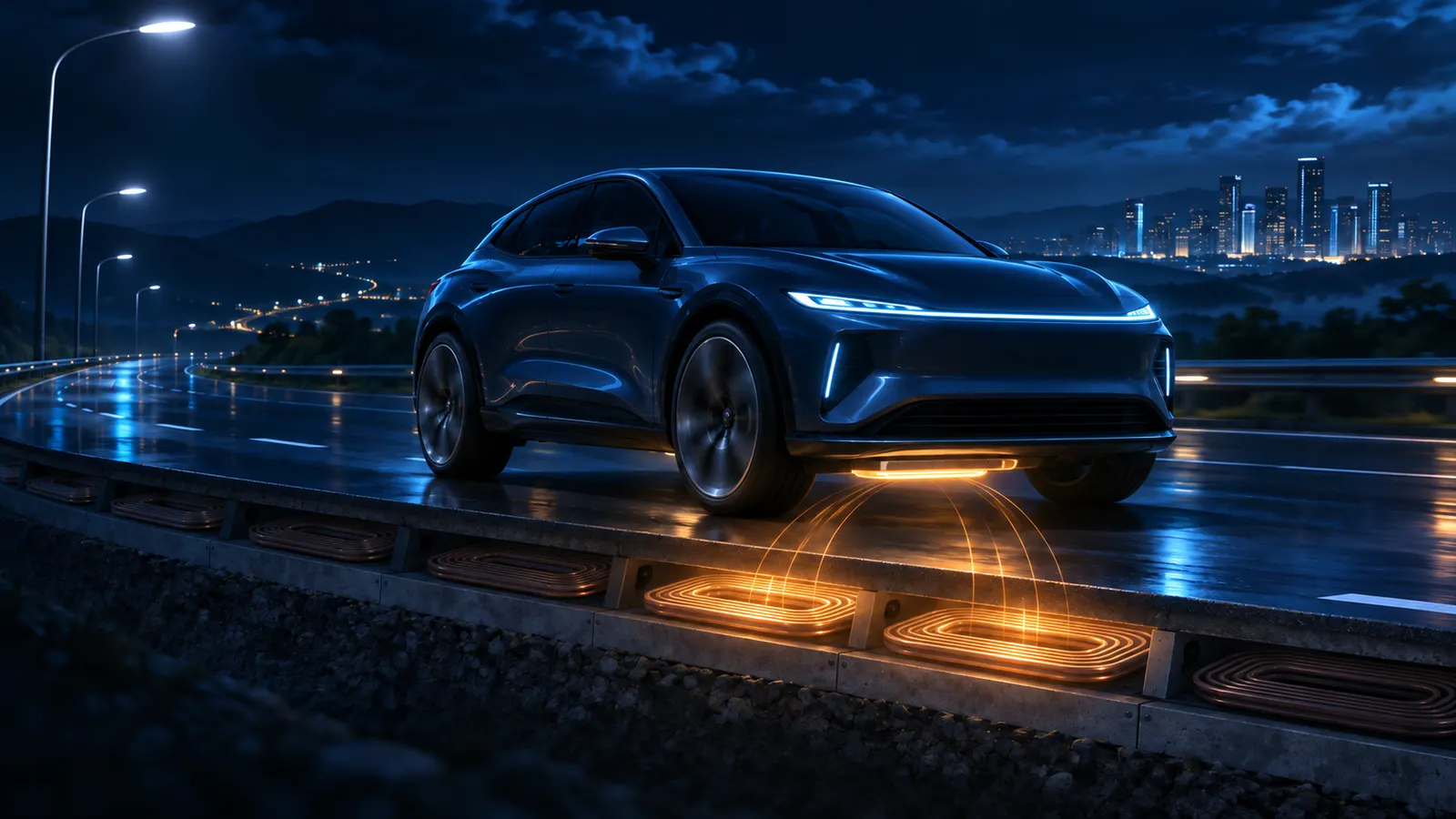
A charging road does not make the asphalt electrically live. It briefly creates a magnetic bridge between equipment buried in the pavement and a matching receiver beneath an electric vehicle. The bridge exists only while an equipped vehicle is above an active segment. [1]
A magnetic bridge
Under the road, power electronics feed alternating current into transmitter coils. The changing current produces a changing magnetic field. When a receiver coil enters that field, the field drives current in the vehicle’s coil; onboard electronics convert it into the form needed by the motor or battery. This is the same broad principle used by small wireless chargers, scaled for larger gaps and much higher power. [1][2]
The roadway is divided into short controlled sections rather than one permanently energized rail. In Indiana’s Purdue–INDOT pilot, 85 coils sit about 2.5 inches beneath a public highway lane. During tests, an authorized receiver triggers the coil below it. An ordinary vehicle receives nothing because the transmitters remain off. [1]
Power is not energy
The goal is not necessarily to fill a battery while the car speeds past. A moving vehicle consumes power continuously. If the road supplies roughly what the drivetrain needs, the battery can hold its state of charge. Any surplus can charge it. Power is the instantaneous transfer rate; energy accumulates only while the vehicle remains over active coils. [1]
Speed changes the time spent above each coil, not the power available at an instant. A slower vehicle can receive more total energy across the same road segment because its receiver remains coupled longer. That timing distinction is why a short test track can prove high power without proving useful range on a real journey. [1]
What pilots have shown
The Indiana testbed reports about 85% efficiency from the roadway inverter’s DC bus to the vehicle’s DC bus at rated power, with a roadway power level of roughly 200 kilowatts. Separate stationary work at Oak Ridge National Laboratory transferred 270 kilowatts to a passenger EV across a 4.75-inch gap at more than 95% efficiency. These figures describe different systems and boundaries, so they should not be treated as a direct ranking. [1][3]
Where it might fit
Dynamic charging could be most useful where vehicles follow predictable routes: freight corridors, buses, ports or taxi lanes. Supplying energy in motion could reduce reliance on long charging stops and, in some designs, allow smaller onboard batteries. But the road still needs grid connections, power electronics, control systems and compatible receivers in vehicles. [1][2]
What to keep in mind
The Indiana installation is a research pilot, not evidence that electrifying entire highway networks is economical. Embedded coils raise construction and maintenance costs, must survive traffic and freeze–thaw cycles, and require interoperable vehicle hardware. Reported efficiencies exclude some upstream losses depending on where measurement begins. [1]
Sources & context
Numbered references link the explanation to its sources. Hypothetical examples and visual metaphors are labelled in the text. Checked 23 November 2026.
- [1] Indiana Department of Transportation — Dynamic Wireless Power Transfer
- [2] U.S. Department of Energy Alternative Fuels Data Center — Electric Vehicle Charging Stations: Inductive Charging
- [3] Oak Ridge National Laboratory — Polyphase wireless power transfer system achieves 270-kilowatt charge (18 June 2024)
KEEP EXPLORING
 One Brain-Activity Score, Two Aging PathsNewsroom · 1 min read
 Some Hessdalen Lights Appeared on RadarPeek · 1 min read
 Why Are Ancient Cities Buried Underground?Explore · 3 min read
CURIOUS MINDS, SHARED IDEAS
Join the conversation
What surprised you? Share a thought or a question.
Loading reader responses…