
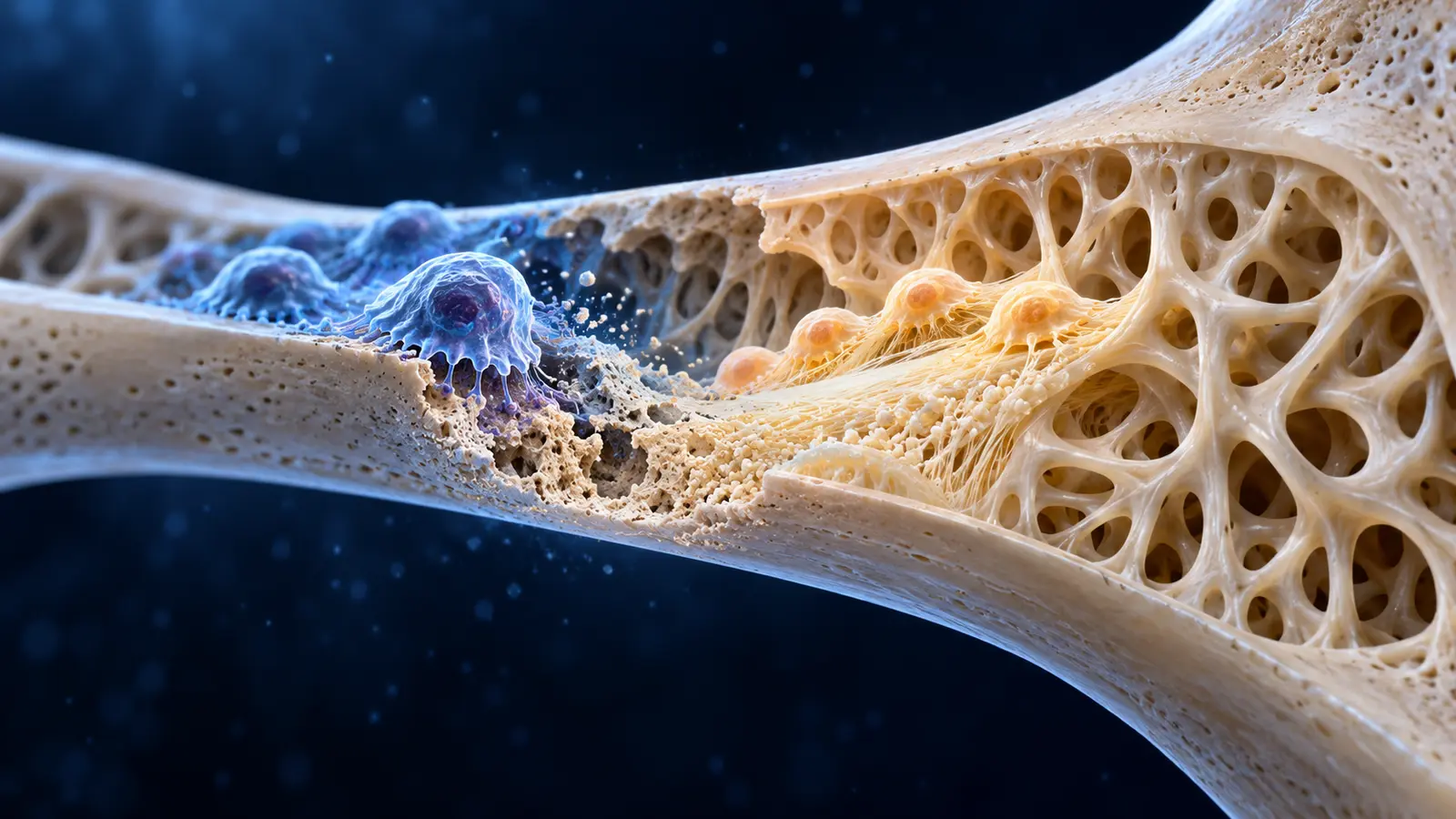
A skeleton looks permanent, but the tissue inside it is busy. To preserve bone, the body repeatedly removes tiny patches and builds them again.
Demolition comes first
Bone remodeling begins when cells called osteoclasts break down and reabsorb old tissue. Osteoblasts follow, laying collagen across the cleared surface; minerals then harden that framework into new bone. Long-lived osteocytes embedded in the tissue help direct when those two cell groups should work. [1]
A living structure
This cycle lets bone renew worn or damaged areas while keeping its larger architecture. It also responds to use: NIAMS notes that osteocytes help regulate remodeling differently when bone is loaded by movement or unloaded by inactivity. In healthy young adults, removal and replacement are roughly balanced. With age or some diseases, removal can outpace formation and weaken bone. [1]
What to keep in mind
Remodeling happens in local sites and at different rates; it does not mean every bone is replaced at once or on one universal timetable. The balance also varies with age, activity and disease.
Sources & context
Numbered references link the explanation to its sources. Hypothetical examples and visual metaphors are labelled in the text. Checked 27 October 2026.
Our editorial principles · Suggest a correctionKEEP EXPLORING
 Helping Cells Read Past a Premature Stop SignalNewsroom · 1 min read
 Why Is the Old City Below the New One?Peek · 2 min read
 Did Diving Help Shape the Body That Later Ran?Explore · 3 min read
CURIOUS MINDS, SHARED IDEAS
Join the conversation
What surprised you? Share a thought or a question.
Loading reader responses…