
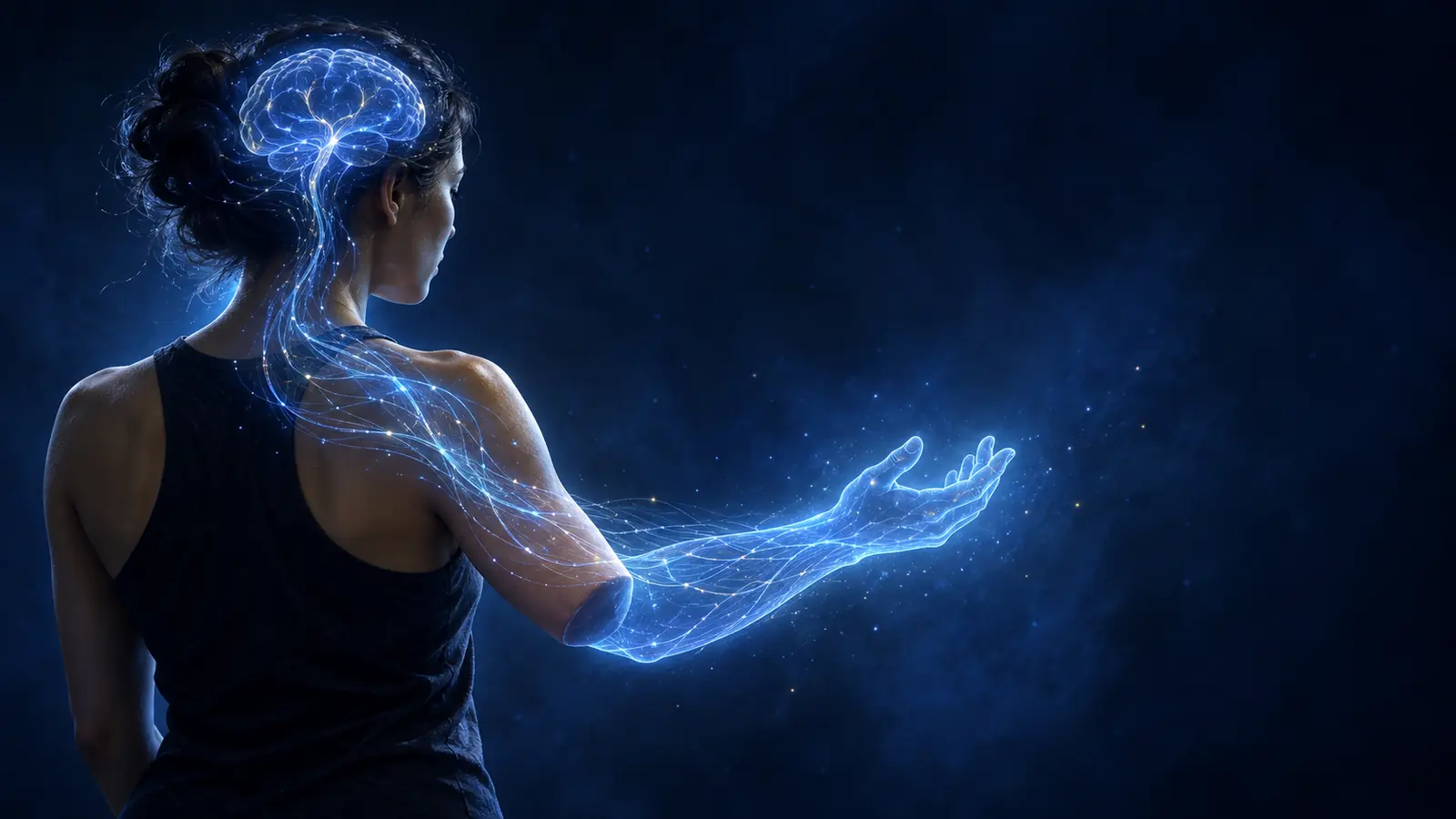
After an amputation, a hand or foot can still feel present. It may seem to move, shrink, itch or hurt. This is neither metaphor nor pretense: the nervous system can keep representing a body part after the body no longer contains it. [1][3]
Sensation is not stored in the limb
A phantom sensation is any non-painful sensation attributed to the missing limb. Phantom limb pain is pain felt as coming from that limb, while residual-limb pain is located in the remaining stump. The three can overlap, but they are not interchangeable. [3] This distinction immediately reveals something important: what you feel as the location of a sensation is not simply the place where a signal began. The brain interprets nerve activity within an organized representation of the body.
An old map may stay online
In 2025, researchers gained a rare opportunity to watch that representation across an amputation. They scanned three adults before planned arm amputations and again for periods ranging from six months to five years afterward. When participants attempted to move individual phantom fingers, the hand and finger patterns in primary sensorimotor cortex remained strikingly similar to their pre-amputation patterns. A computer classifier trained on activity recorded before surgery could still distinguish attempted phantom-finger movements afterward. [1][2]
The remapping story is not settled
The finding challenges a famous textbook story. For decades, researchers often described the cortex for a missing hand as vacant territory that neighboring representations—especially the face—would invade. Earlier work did find reorganization, and the wider scientific debate is not closed. Yet the longitudinal study found no large-scale shift of lip or hand maps in its three participants. The authors argue that preservation and reorganization need not be mutually exclusive, and that analyses which ignore continuing phantom-hand activity can make apparent takeover look larger than it is. [1]
Why presence can become pain
Persistence of a body map can help explain why a missing limb still has a felt position, but it does not by itself explain why that presence becomes painful. The International Association for the Study of Pain says postamputation pain involves interacting peripheral, spinal and brain mechanisms. Pain before amputation can increase later risk, while attention, distress, movement of the residual limb and prosthesis use may alter the experience. [3] A separate IASP review says the exact cause remains unresolved and treatments are supported by uneven evidence. [4]
That complexity explains why phantom pain can be real even without tissue at the place where it is felt. Peripheral nerves, spinal pathways and brain systems can all contribute, while the cortex may continue to model the absent limb. [1][3][4] The experience is generated by the nervous system, not invented by the person.
What to keep in mind
The strongest longitudinal brain-mapping evidence followed only three adults with planned arm amputations. Stable cortical maps do not establish a single cause of phantom pain, and results from upper-limb cases may not generalize to every amputation. Estimates and experiences also vary across populations. This article is educational, not individual medical advice. [1][4]
Sources & context
Numbered references link the explanation to its sources. Hypothetical examples and visual metaphors are labelled in the text. Checked 15 October 2026.
- Schone et al. — Stable cortical body maps before and after arm amputation, Nature Neuroscience (21 August 2025)
- National Institutes of Health — Phantom limb study rewires our understanding of the brain (21 August 2025)
- International Association for the Study of Pain — Postamputation Pain fact sheet
- International Association for the Study of Pain — Current Understanding of Phantom Pain and its Treatment (1 October 2022)
KEEP EXPLORING
 Does a Vivid Memory Have to Be True?Peek · 2 min read
 When Humans Learned to Store Ideas Outside the BrainExplore · 3 min read
 A New Brain Atlas Looks Beneath the DiagnosisNewsroom · 3 min read
CURIOUS MINDS, SHARED IDEAS
Join the conversation
What surprised you? Share a thought or a question.
Loading reader responses…