
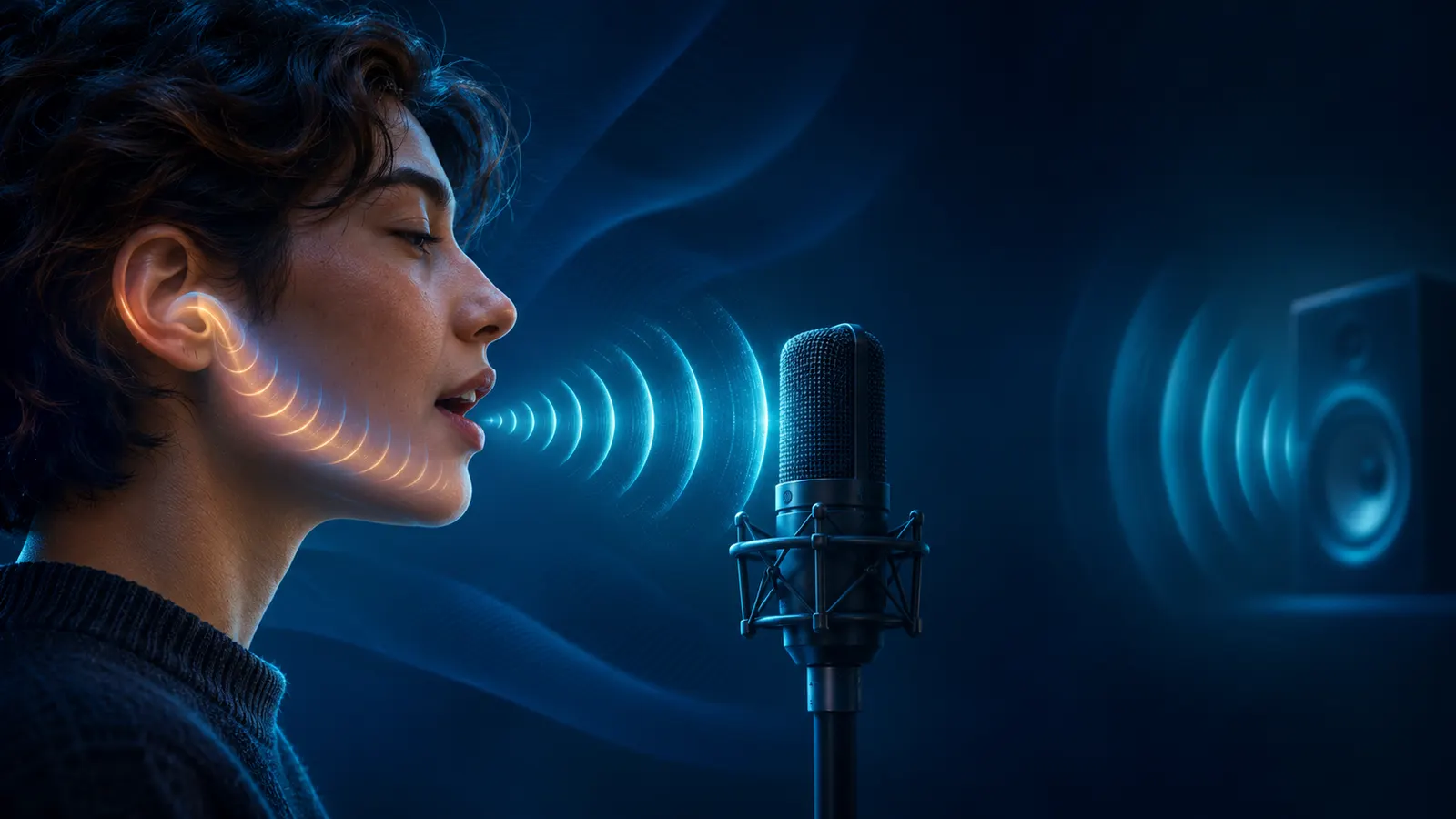
Press record, say a sentence, play it back—and the person in the speaker may sound thinner, higher or simply wrong. The microphone has not necessarily betrayed you. It captured only part of the voice you normally hear, while your brain compared that partial signal with a deeply familiar internal reference.
One voice, two routes
When another person speaks, sound waves travel through the air into your ear canal. They vibrate the eardrum and the tiny middle-ear bones, which pass energy into the fluid-filled cochlea. Hair cells convert that motion into electrical signals carried to the brain [1]. A loudspeaker sends your recorded voice along this same air-conduction route.
Speaking adds a second route. Vibrations produced by your vocal system also reach the inner ear through the tissues and bones of your head. An ordinary external microphone mainly captures pressure changes in the air, so playback leaves out much of this bone-conducted component [2]. Live self-voice and recorded self-voice are therefore physically different inputs.
More than a bass boost
Bone conduction is more complicated than simply adding bass. In a 2010 experiment involving ten spoken phonemes, its contribution relative to air conduction varied with frequency and the sound being produced; for most tested phonemes, the bone-conducted part dominated between 1 and 2 kilohertz [2]. The route also carries vibration that can be felt, making a naturally heard self-voice a multisensory event rather than audio alone [3].
A 2023 study tested voice morphs with air-conducted sound and bone-conducted vibration. Adding the bodily component improved participants’ ability to distinguish their own voice from another person’s voice. It did not produce the same advantage for distinguishing familiar people from each other, suggesting that bone conduction contributes specifically to the sense of “me” in a voice [3].
The brain knows your signature
Your brain also learns the signature it expects. In a 2021 brain-imaging study, participants heard filtered versions of their own recordings. Regions in the superior temporal cortex responded more strongly to versions judged least like the person’s own voice than to versions judged most similar. The researchers interpreted this as evidence that the auditory system sharpens its representation of self-voice [4].
Can playback be corrected?
Could software make a recording sound “right”? Equalization can imitate some filtering, and bone-conduction playback can restore vibration, but there is no universal correction. Experiments report substantial individual differences in which filtered version sounds most self-like [4]. Previous exposure also made self–other discrimination easier in part of the 2023 study [3].
What to keep in mind
The balance of air and bone conduction varies with frequency and phoneme [2]. The cited studies used controlled phoneme, voice-morphing and filtered-recording tasks [2][3][4], so they do not reproduce every everyday speaking situation. Air-only playback omits bone-conducted input, but the feeling of strangeness is not reducible to one fixed frequency shift [3][4].
Sources & context
Numbered references link the explanation to its sources. Hypothetical examples and visual metaphors are labelled in the text. Checked 19 November 2026.
- National Institute on Deafness and Other Communication Disorders — How Do We Hear?
- Reinfeldt et al. — Hearing one’s own voice during phoneme vocalization: transmission by air and bone conduction
- Orepic et al. — Bone conduction facilitates self-other voice discrimination
- Hosaka, Kimura & Yotsumoto — Neural representations of own-voice in the human auditory cortex
KEEP EXPLORING
 Why Does a Room Stop Smelling?Explore · 3 min read
 One Brain-Activity Score, Two Aging PathsNewsroom · 1 min read
 Does a Vivid Memory Have to Be True?Peek · 2 min read
CURIOUS MINDS, SHARED IDEAS
Join the conversation
What surprised you? Share a thought or a question.
Loading reader responses…