
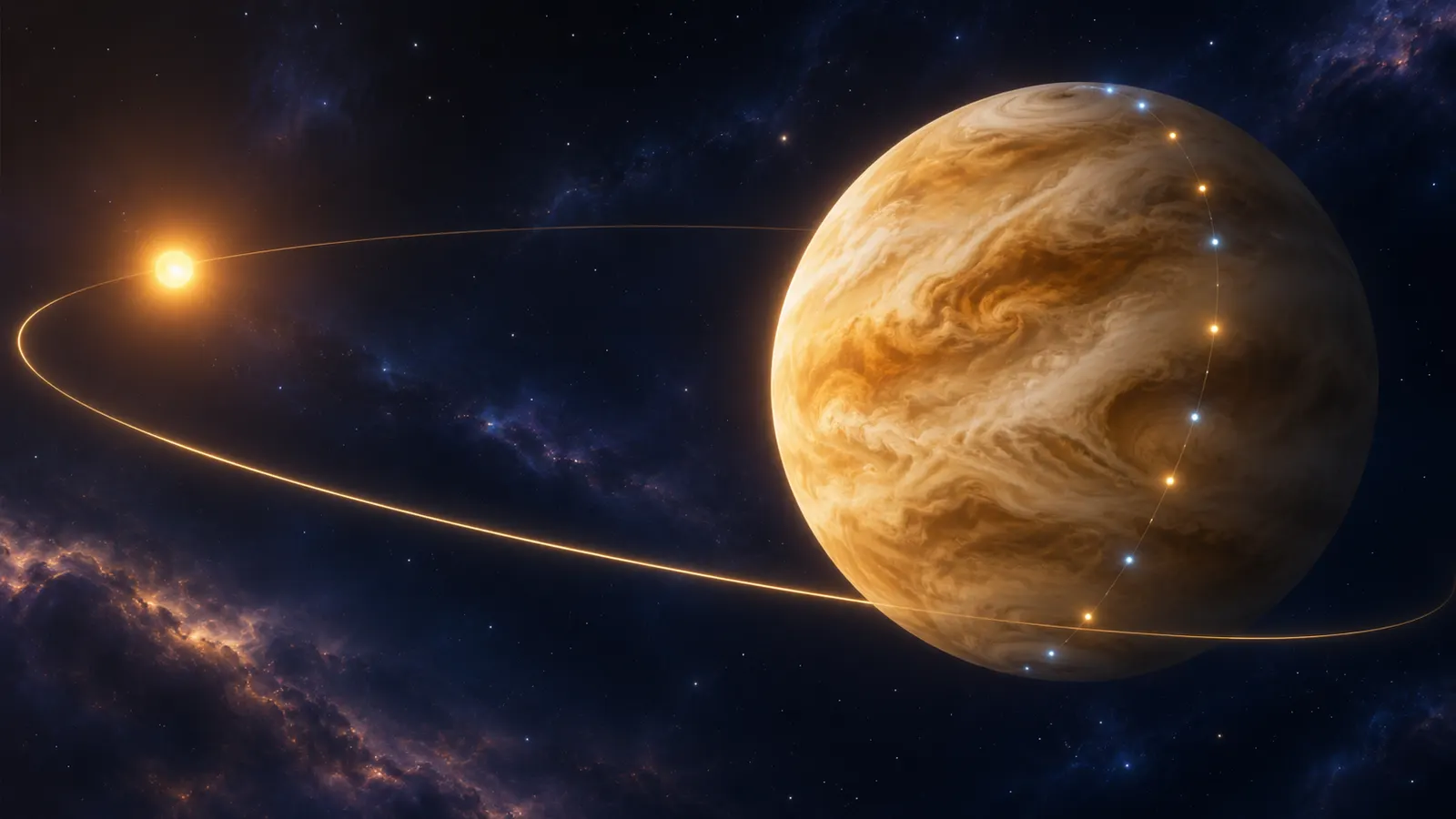
On Venus, the calendar wins a race against the clock. The planet completes an entire journey around the Sun before it finishes one rotation relative to the distant stars.
The longer turn
A Venusian year lasts about 224.7 Earth days. One sidereal rotation—the time needed to turn once against the fixed stars—takes about 243.7 Earth days [1][2]. NASA lists that rotation with a minus sign because Venus spins retrograde, opposite the direction used as positive for most planets [2][3].
Why noon returns sooner
But “day” has another meaning. A solar day measures the interval from one noon to the next. On Venus that takes about 116.75 Earth days, far shorter than the planet’s full rotation [2][3]. Because Venus turns backward while also traveling around the Sun, those two motions bring the Sun back to the same position in the sky before the planet completes a 360-degree turn against the stars. Sunrise would arrive in the west and sunset in the east [1].
What to keep in mind
The numbers are rounded averages. “Rotation period” here means motion relative to fixed stars, while “solar day” means noon to noon; treating them as the same kind of day creates the apparent contradiction.
Sources & context
Numbered references link the explanation to its sources. Hypothetical examples and visual metaphors are labelled in the text. Checked 20 November 2026.
- NASA Science — Venus: Facts
- NASA Goddard — Venus Fact Sheet
- NASA Goddard — Notes on the Planetary Fact Sheets
KEEP EXPLORING
 The Energy Problem Nobody SeesExplore · 3 min read
 A Heat Pump Moves More Heat Than It MakesPeek · 1 min read
 Helping Cells Read Past a Premature Stop SignalNewsroom · 1 min read
CURIOUS MINDS, SHARED IDEAS
Join the conversation
What surprised you? Share a thought or a question.
Loading reader responses…