
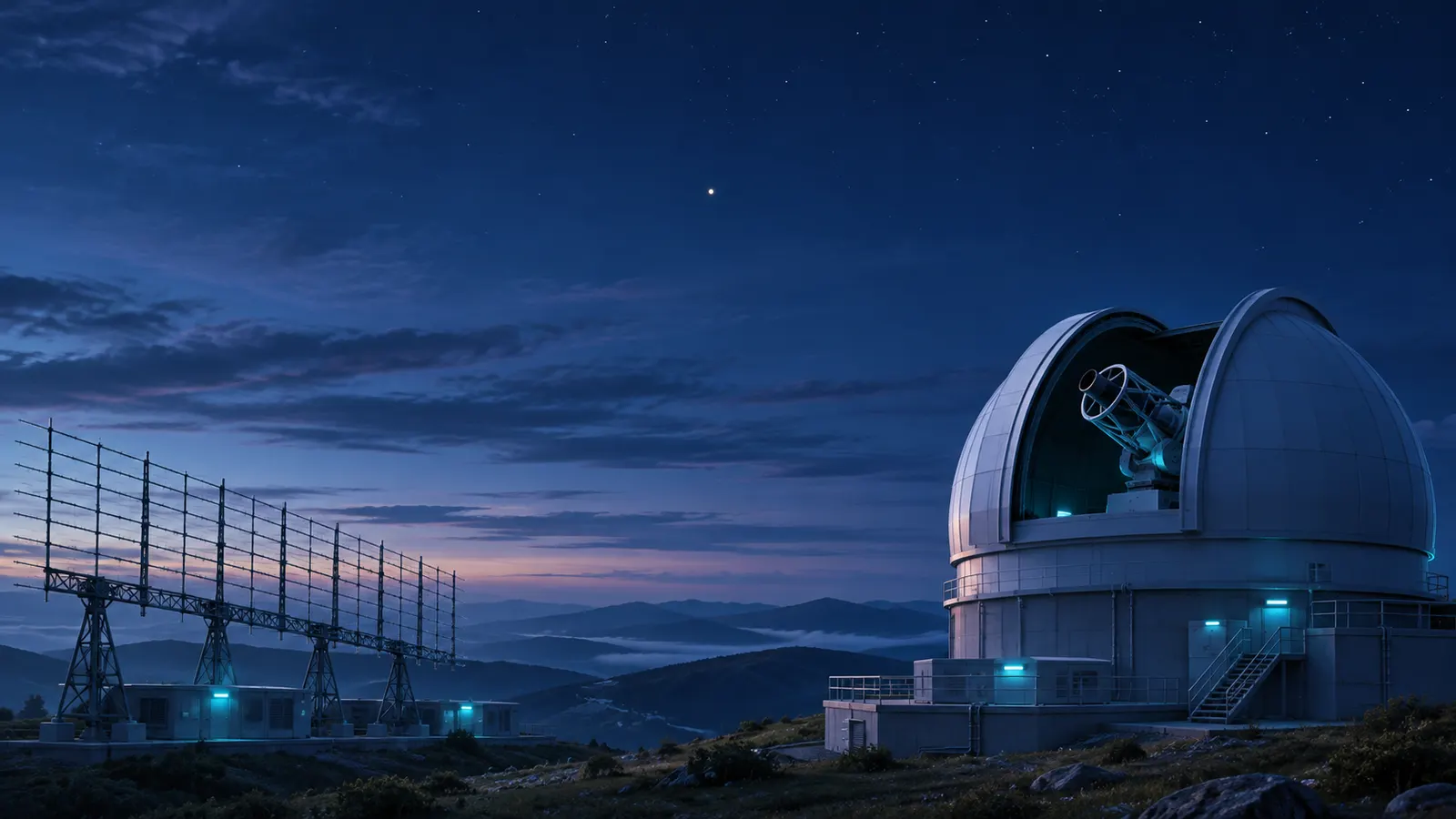
Most unusual sky reports end with a blurry image and no reliable distance. A planned observatory in Ithaca aims to collect several measurements at once instead.
What was announced
On November 10, Galileo Project director Avi Loeb announced a facility that would use passive radar to scan the sky, software to filter familiar aircraft and satellites, and a 0.7-metre telescope for detailed images and spectra [1]. The attached release is dated November 5.
Why the combination matters
A peer-reviewed 2023 paper from the project described why this combination matters: radar can constrain position and motion, while narrow-field instruments examine shape and light. Independent sensor modes can help expose artifacts and corroborate real detections [2][3].
What to keep in mind
The Ithaca observatory is planned, not commissioned, and the announcement reports no detection. The announcement itself is not peer reviewed; only the earlier instrumentation framework is. Results will depend on calibration, weather, target timing and transparent data.
Sources & context
Numbered references link the explanation to its sources. Hypothetical examples and visual metaphors are labelled in the text. Checked 18 November 2026.
- A New Galileo Project Observatory for High-Resolution Imaging and Spectroscopy of UAP
- The Scientific Investigation of Unidentified Aerial Phenomena (UAP) Using Multimodal Ground-Based Observatories
- Northumbria University research record: peer-reviewed journal article
KEEP EXPLORING
 What Would Count as Proof of Alien Life?Explore · 3 min read
 Some Hessdalen Lights Appeared on RadarPeek · 1 min read
 German Lawmakers Ask Who Handles UAP ReportsNewsroom · 1 min read
CURIOUS MINDS, SHARED IDEAS
Join the conversation
What surprised you? Share a thought or a question.
Loading reader responses…