
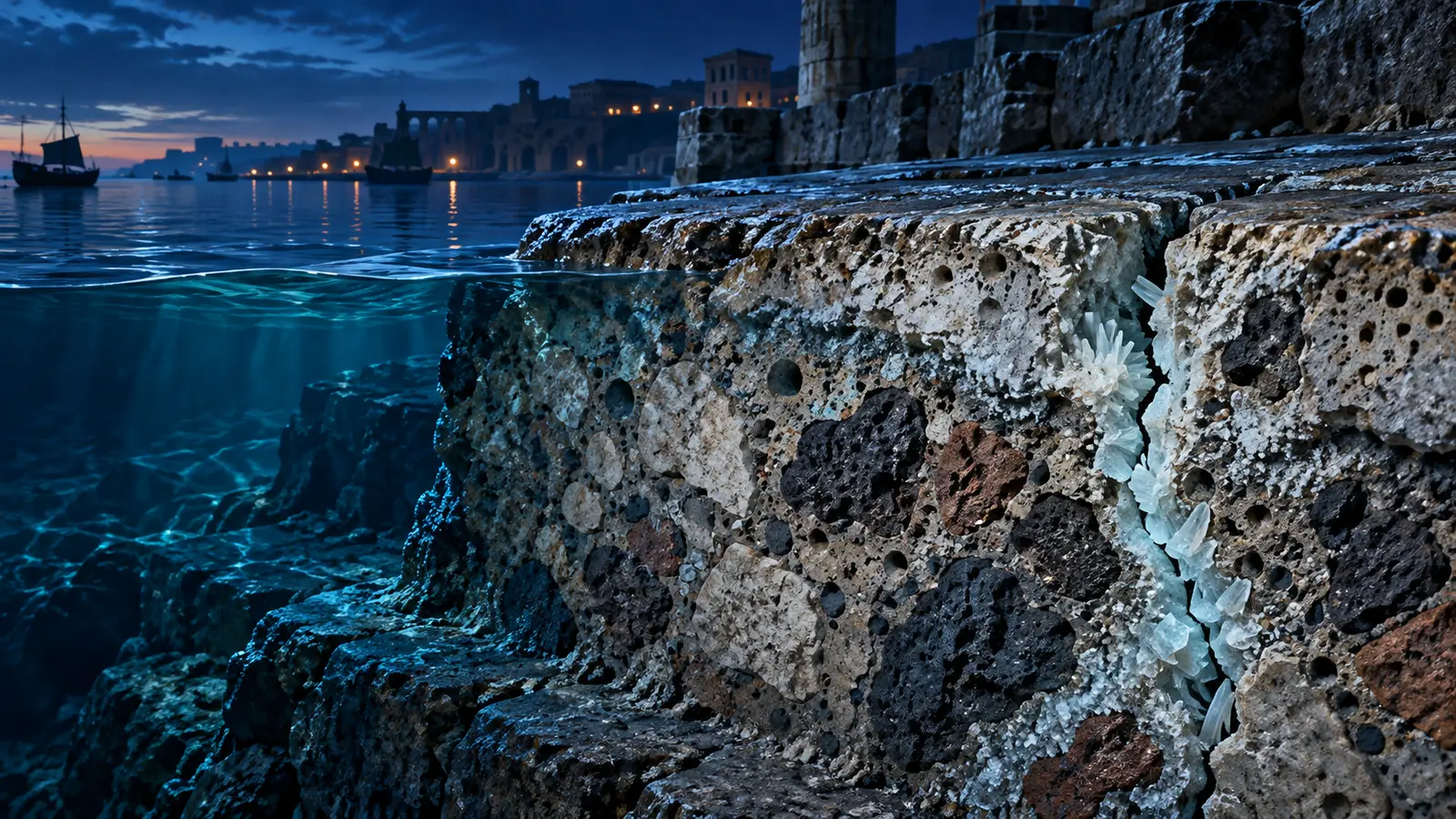
A crack usually marks the beginning of a structure’s decline. In some Roman concrete, however, cracks and pores became places where new minerals could form. The surprise is not a single lost formula: different mixtures interacted with heat, air or seawater in different ways, and some kept changing long after construction.
Concrete was a family of recipes
Roman concrete sounds like a product with one standard formula. It was not. Builders combined lime, water and aggregate, often adding volcanic material that reacted with lime to make a durable binder. But ingredients and exposure varied. A harbor wall continuously washed by seawater was a different chemical system from an inland floor or vault. That is why researchers study concrete from named structures rather than treating every Roman ruin as evidence for the same mechanism. [1][2][3]
This also corrects a popular comparison. The ancient material was generally massive and unreinforced, while much modern concrete contains steel that supplies tensile strength. In marine settings, chloride can corrode that steel and trigger cracking. Roman harbor concrete avoided that particular vulnerability, but it was designed for different loads, shapes and building practices. [3]
Heat could leave useful weak spots
A 2023 peer-reviewed study examined lime-rich fragments, or lime clasts, in Roman architectural mortar. Chemical and structural mapping supported hot mixing: builders appear to have used quicklime with, or instead of, previously slaked lime. The reaction generated heat and left brittle, calcium-rich clasts inside the hardened material. [1]
A small crack may preferentially pass through one of those clasts. If water enters, the exposed calcium can dissolve and later recrystallize as calcium carbonate, filling space in the crack. Modern mixtures made by the researchers with similar lime clasts showed self-healing potential. The study therefore offers a mechanism supported by samples and laboratory tests—not proof that every Roman wall could repair any damage. [1]
Air could strengthen the material slowly
Another peer-reviewed study, published in 2026, investigated second-century concrete from a latrine at Hadrian’s Villa. Three-dimensional X-ray imaging, spectroscopy and microscopy revealed networks of calcite inside pores and fractures. The researchers concluded that long-term carbonation—reactions involving carbon dioxide, moisture and calcium compounds—helped bind and densify this particular concrete over centuries, limiting pathways for water and helping seal fine cracks. [2]
That process is compatible with hot mixing, but it is not identical to it. One emphasizes reactive lime clasts; the other shows mineralized carbonate growing through an old concrete matrix. Together they make the secret-ingredient story look too simple.
Seawater opened a third route
Roman marine concrete adds another mechanism. A 2017 mineralogical study of ancient harbor cores found that seawater moving through volcanic material helped dissolve some phases and supported the growth of phillipsite and aluminum-rich tobermorite in pores and aggregate. These minerals contributed to a cementing system that continued evolving at low temperature over very long periods. [3]
The water was therefore not merely an enemy kept outside. In the right volcanic mixture, it became part of the material’s geological afterlife. That does not mean any old concrete improves when soaked; the result depended on specific ingredients, structures and environments.
What to keep in mind
Only selected structures survived long enough to study, so survival bias matters. The cited mechanisms come from specific sites and laboratory replicas, and researchers should not assume that all Roman concrete self-healed or outperformed modern reinforced concrete. Reproducing an ancient recipe at modern scale must also satisfy today’s strength, safety and consistency requirements.
Sources & context
Numbered references link the explanation to its sources. Hypothetical examples and visual metaphors are labelled in the text. Checked 19 October 2026.
- Masic et al. — Hot mixing: Mechanistic insights into the durability of ancient Roman concrete (Science Advances, 6 January 2023)
- Zhu et al. — Mineralized carbonates contribute to the millennial durability of Roman concrete (Science Advances, 8 July 2026)
- Jackson et al. — Phillipsite and Al-tobermorite mineral cements produced through low temperature water-rock reactions in Roman marine concrete (American Mineralogist, 2017)
KEEP EXPLORING
 A Martian Rock Can Remember More Than One Kind of WaterNewsroom · 3 min read
 A Medieval Skeleton Cannot Tell Us Which Side He TookPeek · 1 min read
 Why Are Ancient Cities Buried Underground?Explore · 3 min read
CURIOUS MINDS, SHARED IDEAS
Join the conversation
What surprised you? Share a thought or a question.
Loading reader responses…