
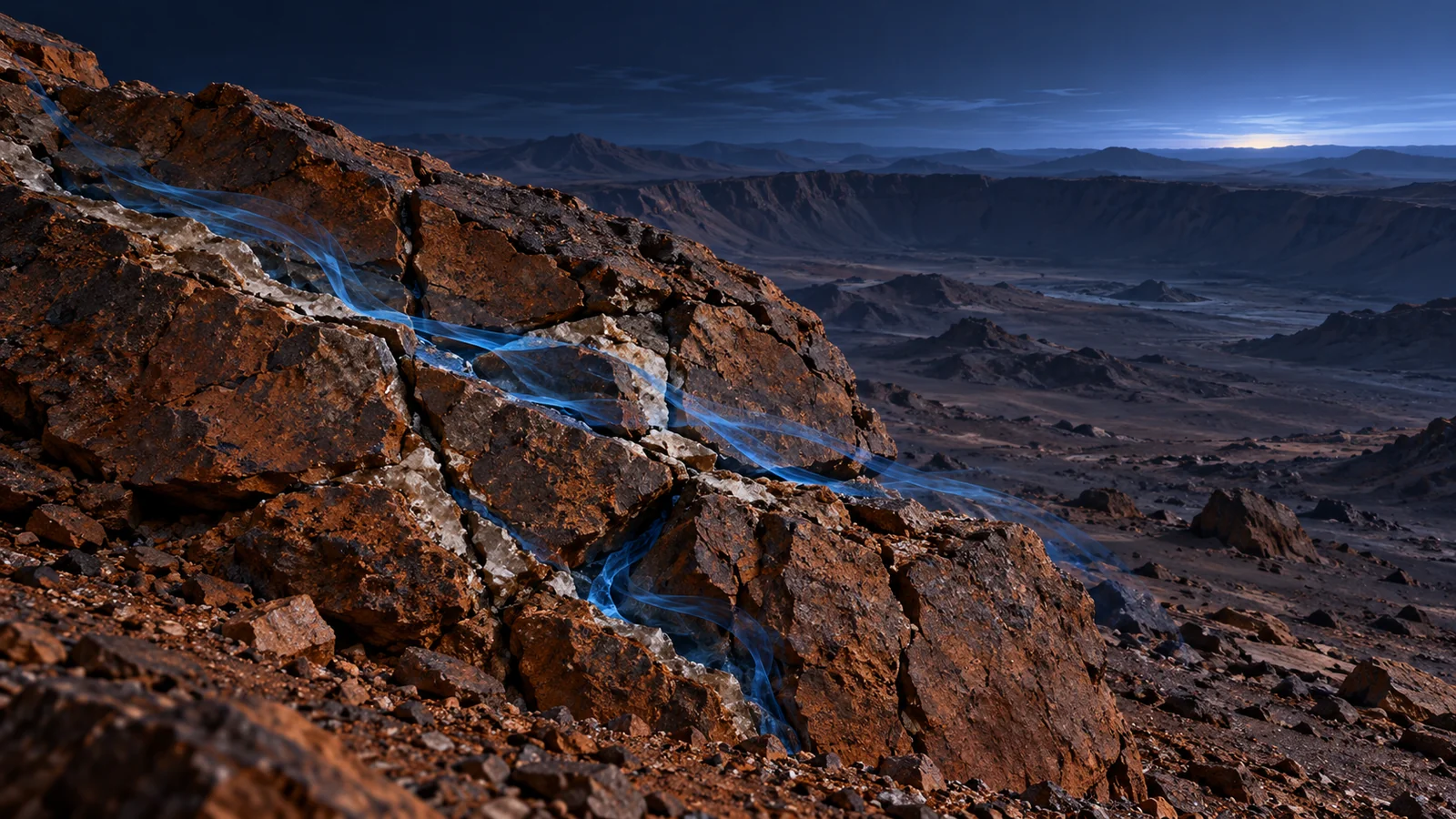
If water altered the same rock several times, how do you untangle its history?
One rock, several histories
A rock can be a record that has been edited more than once. That is the useful way to read new findings from Jezero Crater on Mars: the question is no longer simply whether water reached these rocks, but which water arrived, and in what order.
NASA’s Jet Propulsion Laboratory announced the findings on 21 September 2026. The original study, led by Candice C. Bedford and published that day in Communications Earth & Environment, is peer reviewed, not a preprint. Its subject is the crater’s Margin unit, investigated by Perseverance. [1, 2]
How to read a vanished environment
From orbit, carbonate minerals had made this region look promising as an ancient lakeshore. Close inspection instead revealed igneous rocks carrying a complicated record of later contact with water. JPL reports that the rover reached the area in September 2023: the announcement is new, while the observations began years earlier. [2]
The tools matter here. SuperCam combines a camera, laser and spectrometers to investigate rock chemistry and mineral composition. Mastcam-Z supplies detailed, zoomable views of the terrain. The result is a way to connect what a rock looks like with what it contains, rather than relying on its appearance alone. [3]
The sequence written in minerals
The researchers identify three main alteration episodes. Carbon-dioxide-rich fluids first produced carbonate-rich fracture fillings. Later fluids redistributed carbonate and deposited silica in pore spaces. Younger fractures then acquired calcium-sulfate and fluorite-bearing veins, interpreted as evidence of a later hydrothermal episode. These are mineral clues supporting a reconstruction, not a direct observation of ancient flowing water. [1]
One important ambiguity remains: lake water and changing groundwater can produce competing explanations for parts of this history. The paper explicitly considers alternatives. More mineral detail has made the story richer without making every step certain. [1]
Why this matters
The aha is that finding water is only the beginning. Understanding its changing relationship with rock helps scientists reconstruct possible environments for ancient life. JPL notes that water reacting with olivine on Earth can release hydrogen used by some microbes. That comparison explains the interest; it does not establish that Mars hosted those microbes. [2]
Treat this as progress in reconstructing a possible habitat. Evidence for an environment that could support life and evidence that life actually existed answer different questions.
What to keep in mind
The ages of these water episodes remain unresolved. Lake versus groundwater contributions are uncertain, and the inferred hydrothermal history is a geological interpretation. This study does not demonstrate Martian life. [1, 2]
Sources & context
Numbered references link the explanation to its sources. Hypothetical examples and visual metaphors are labelled in the text. Checked 3 October 2026.
- Original study: Bedford et al. — Lake- and groundwater-associated alteration of the olivine-rich Margin unit in Jezero crater, Mars (21 September 2026)
- Announcement: NASA/JPL — NASA Discovery Reveals Complex Water Systems on Early Mars (21 September 2026)
- Background: NASA — Perseverance Science Instruments
KEEP EXPLORING
 Roman Concrete Had More Than One Way to EndureExplore · 4 min read
 Could Moon Dust Become a Search for Ancient Technology?Newsroom · 3 min read
 A Medieval Skeleton Cannot Tell Us Which Side He TookPeek · 1 min read
CURIOUS MINDS, SHARED IDEAS
Join the conversation
What surprised you? Share a thought or a question.
Loading reader responses…