
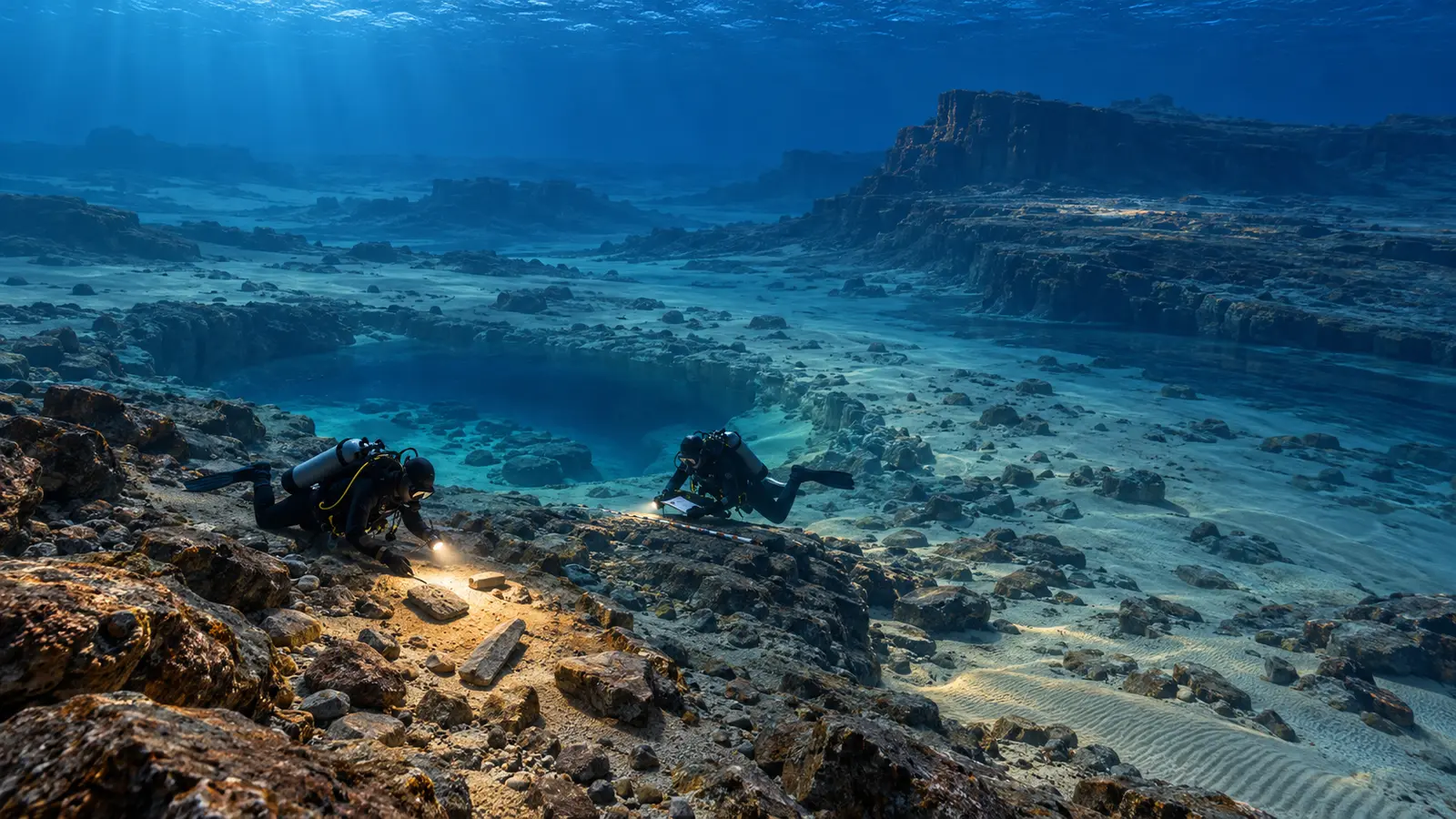
The seabed off Murujuga, Western Australia, was once dry country. Two newly documented sites now show that its archaeological story extends beyond today’s shoreline.
Two sites below the shoreline
Archaeologists and Murujuga Rangers found more than 20 stone artefacts across two sites in 10–15 metres of water. One lies around an ancient freshwater spring; the other relates to a rocky hill above a former river channel. The landscape was submerged at least 9,000 years ago, although the artefacts may be older. [1][2][3]
Stone travelled across the old landscape
Stone analysis linked some artefacts to material around Rosemary Island, roughly 23 kilometres from where they were recovered. That establishes movement of selected rock across the former landscape, but not whether individuals carried it directly or obtained it through exchange. The peer-reviewed study appeared in Quaternary Science Reviews and was announced by Flinders University on 14 October 2026. [1][2]
What to keep in mind
Submergence constrains the sites but does not give precise ages for the artefacts or reveal how long people used either place. Much of the submerged shelf remains unexplored.
Sources & context
Numbered references link the explanation to its sources. Hypothetical examples and visual metaphors are labelled in the text. Checked 24 October 2026.
- Benjamin et al. — Underwater archaeological discoveries demonstrate raw material selection and transport of stone artefacts (Quaternary Science Reviews, 2026)
- Flinders University — Australia’s oldest underwater archaeology reveals ancient life within a lost landscape (14 October 2026)
- ABC News — Newly discovered underwater sites off WA’s Burrup Peninsula give clues to ancient ways of life (14 October 2026)
KEEP EXPLORING
 The White Statue May Be the Faded VersionPeek · 1 min read
 Why a Viking Dig Can Keep Answering Questions for 50 YearsExplore · 3 min read
 How Do You Move a Stone That Weighs 100 Tons?Explore · 3 min read
CURIOUS MINDS, SHARED IDEAS
Join the conversation
What surprised you? Share a thought or a question.
Loading reader responses…