
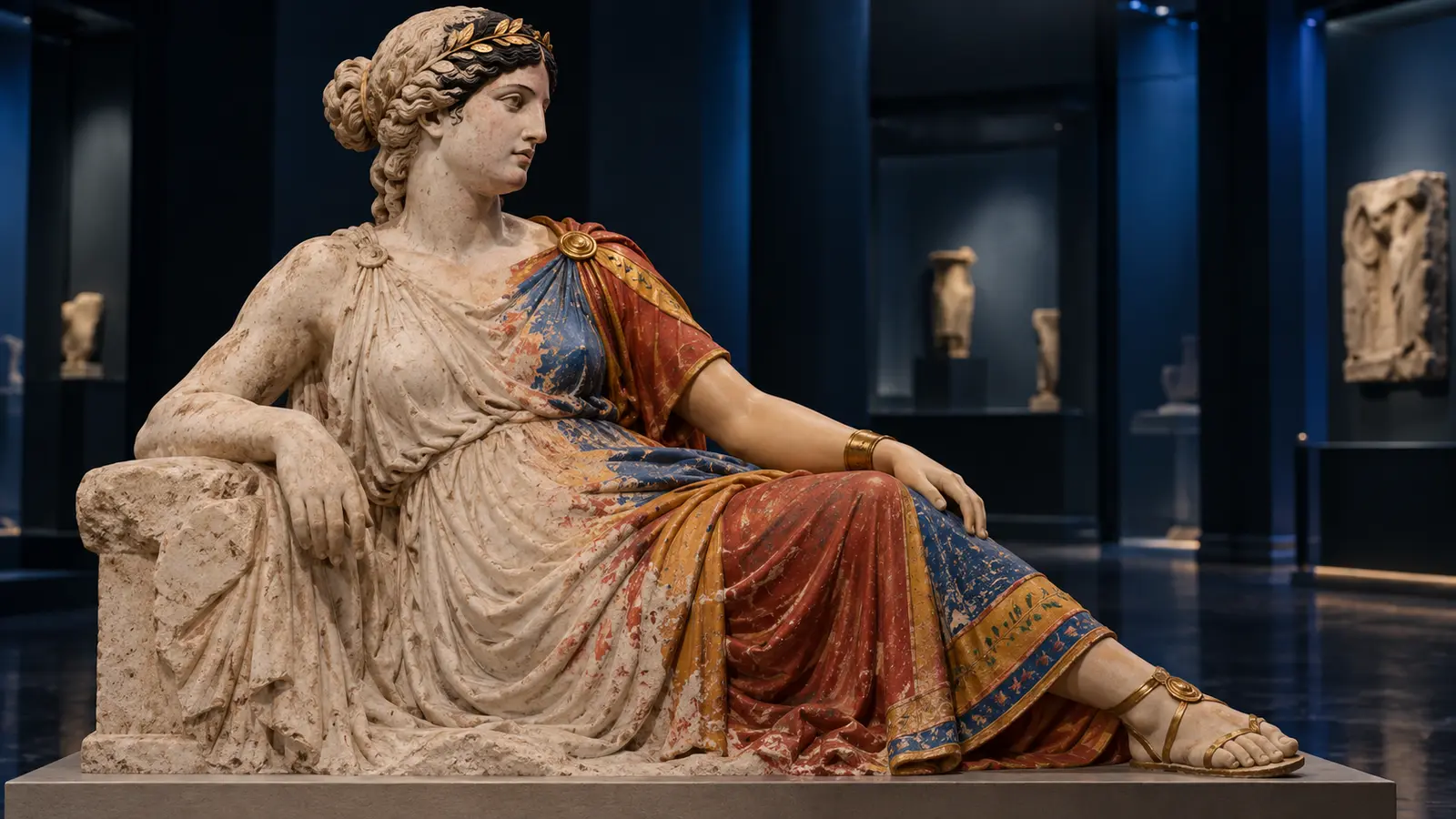
A marble figure that looks timelessly white may be showing its afterlife, not the appearance its ancient makers intended.
The marble was a surface
Greek and Roman sculptors often treated marble as a surface for color. Paint could cover an entire statue or pick out hair, eyes, lips, clothing and ornaments; gilding and metal inlays added more. Centuries of burial stripped much of that finish away. Later restoration and cleaning removed still more, leaving many rediscovered works almost bare. Their whiteness helped inspire Renaissance and later European ideals of classical sculpture. [1][2]
Color leaves evidence behind
The missing paint is not guesswork alone. Researchers use microscopy, ultraviolet and infrared photography, multispectral imaging, X-ray diffraction and material analysis to find pigment grains and patterns too faint for ordinary viewing. On some Cycladic figures, faint outlines remain where painted eyes, hair or jewelry weathered differently from the surrounding stone. [1][2]
What to keep in mind
Color reconstructions remain interpretations. Pigment survives unevenly, so researchers can identify some materials and patterns without knowing every original shade, layer or visual effect.
Sources & context
Numbered references link the explanation to its sources. Hypothetical examples and visual metaphors are labelled in the text. Checked 30 October 2026.
- The Metropolitan Museum of Art — Polychromy of Roman Marble Sculpture
- The Metropolitan Museum of Art — Chroma: Ancient Sculpture in Color, visiting guide
KEEP EXPLORING
 Why Does the Aurora Change Color?Explore · 3 min read
 Patients Helped an Epilepsy Monitor Learn Its MistakesNewsroom · 2 min read
 The Bayeux Story Is Also a Story About CopiesPeek · 1 min read
CURIOUS MINDS, SHARED IDEAS
Join the conversation
What surprised you? Share a thought or a question.
Loading reader responses…