
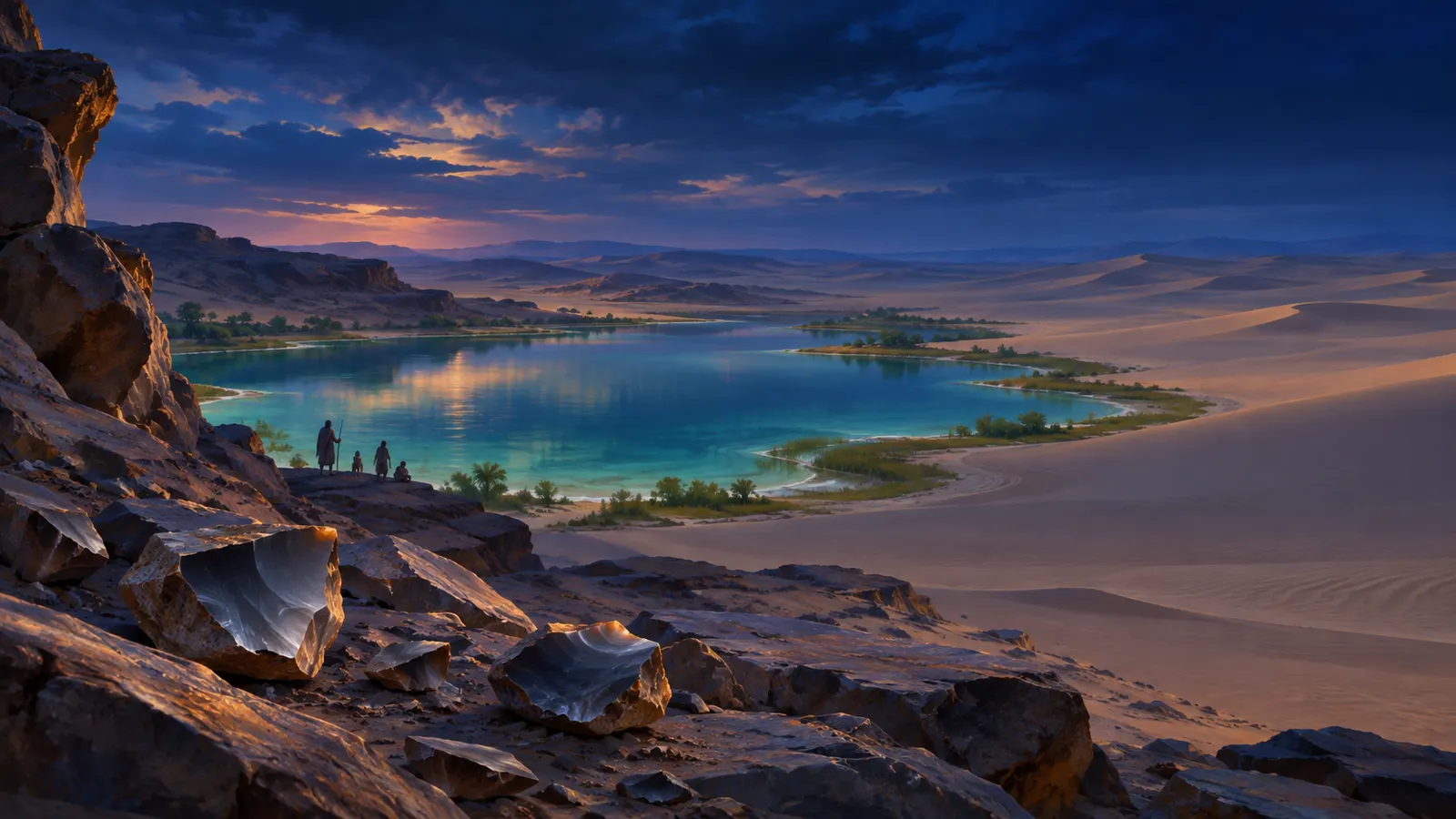
A green desert could still be difficult to inhabit. Across Arabia’s Empty Quarter, ancient lakes appeared without the stone that early people needed to keep making tools.
Water, but no toolkit
Researchers surveyed roughly 1,500 kilometres through the Rub’ al Khali, recording ancient lake deposits at 55 of 125 locations. They found no stone artefacts or workable toolstone along the route, although more than 95 percent of the ground was visible. [1][2] That contrast suggested water was only half of the settlement equation.
Why stone changes the map
A spatial model tested against known Arabian sites performed better when it combined freshwater with exposed knappable rock. Across the peninsula, 57 percent of water-accessible terrain lay on formations without suitable stone. [2][3] The peer-reviewed Nature paper was published on 28 October and announced by the Czech Academy of Sciences on 29 October; it is not a preprint. [1][2]
What to keep in mind
No artefacts on this transect do not prove nobody ever crossed the interior. The study addresses archaeologically visible, sustained occupation; sand, brief visits and unknown behaviour can escape detection.
Sources & context
Numbered references link the explanation to its sources. Hypothetical examples and visual metaphors are labelled in the text. Checked 4 November 2026.
- Czech Academy of Sciences — Stone and water determined human settlement of the desert (29 October 2026)
- Dellmour et al. — Stone and water governed early human settlement of the desert, Nature (28 October 2026)
- ICArEHB — Institutional research summary (30 October 2026)
KEEP EXPLORING
 Roman Concrete Had More Than One Way to EndureExplore · 4 min read
 A Workshop Reveals Lismore’s Monastic ImportanceNewsroom · 1 min read
 A Medieval Skeleton Cannot Tell Us Which Side He TookPeek · 1 min read
CURIOUS MINDS, SHARED IDEAS
Join the conversation
What surprised you? Share a thought or a question.
Loading reader responses…