
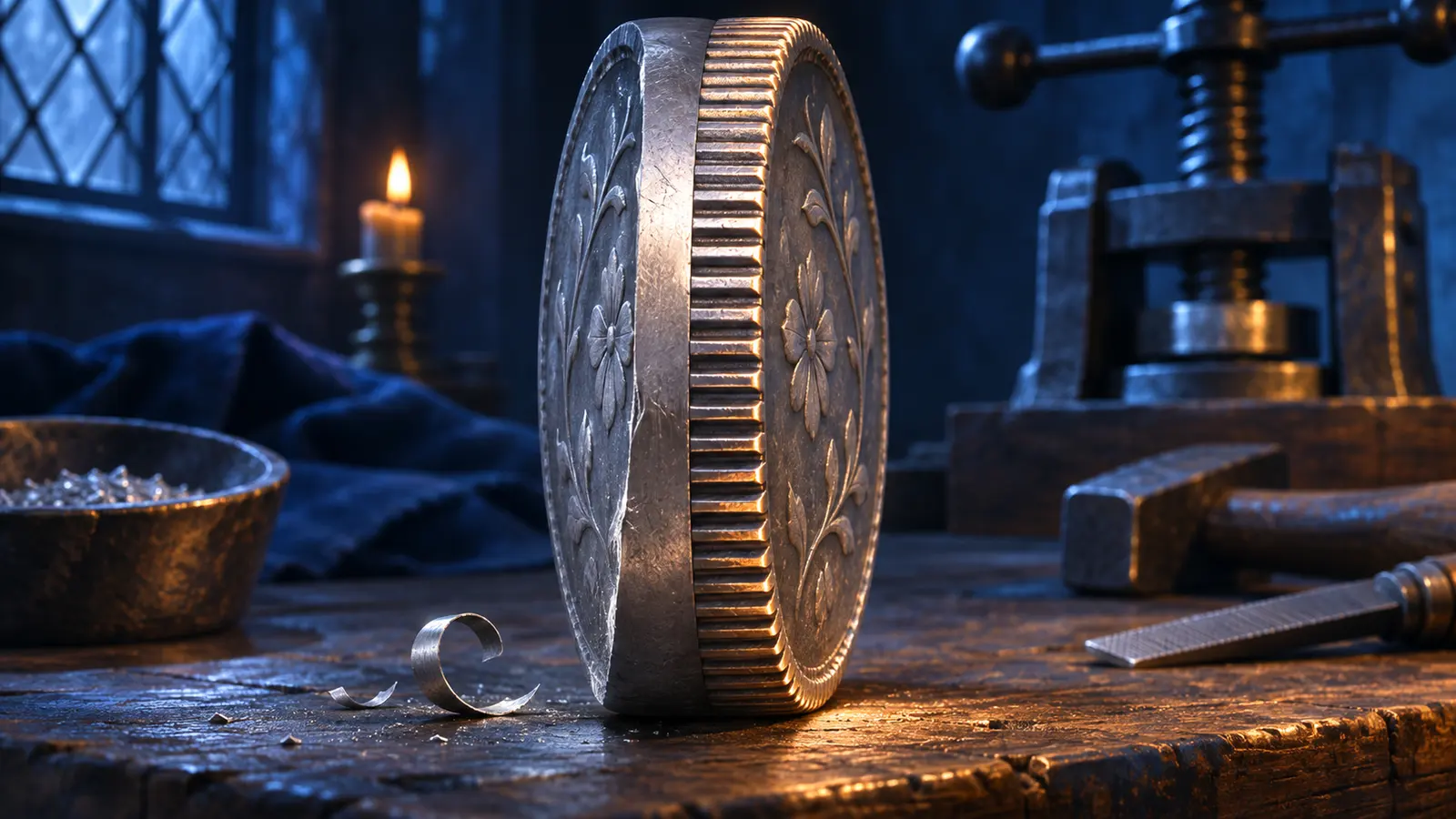
Run a fingertip around some coins and you feel a row of tiny ridges. That texture was not invented merely for decoration. It helped turn the edge—the easiest place to steal precious metal—into a visible security seal.
The crime was called clipping
For centuries, many coins were valued partly by the gold or silver they contained. Hand-struck coins were thin and irregular, so a person could shave or file a little metal from the edge, melt the clippings into bullion and still spend the lighter coin. This theft was called clipping. [1]
A pattern made theft visible
Mechanised minting changed the geometry. In Britain, new machinery produced thicker, more uniform coins and could add milling or lettering around the edge. If metal was removed, the regular pattern or inscription was damaged, making tampering easier to spot. Machine-struck gold production began in 1662, followed by silver denominations. [2]
The third side remains
Modern edges can be plain, reeded, lettered or decorated. Ordinary British circulating coins no longer contain precious metal equal to their face value, but the “third side” still carries design and security information. [1][3]
What to keep in mind
Not every ridged coin has the same history or purpose, and edge designs differ by country and denomination. The anti-clipping explanation applies most directly to precious-metal coinage.
Sources & context
Numbered references link the explanation to its sources. Hypothetical examples and visual metaphors are labelled in the text. Checked 10 November 2026.
- [1] The Royal Mint — Clippers and Counterfeiters
- [2] Royal Mint Museum — Charles II and the mechanisation of coinage
- [3] United States Mint — Anatomy of a Coin
KEEP EXPLORING
 Why Do Some Booms Have No Visible Source?Explore · 3 min read
 Some Hessdalen Lights Appeared on RadarPeek · 1 min read
 Ireland’s Earliest Human Trace May Be Hiding on Two BonesNewsroom · 1 min read
CURIOUS MINDS, SHARED IDEAS
Join the conversation
What surprised you? Share a thought or a question.
Loading reader responses…