
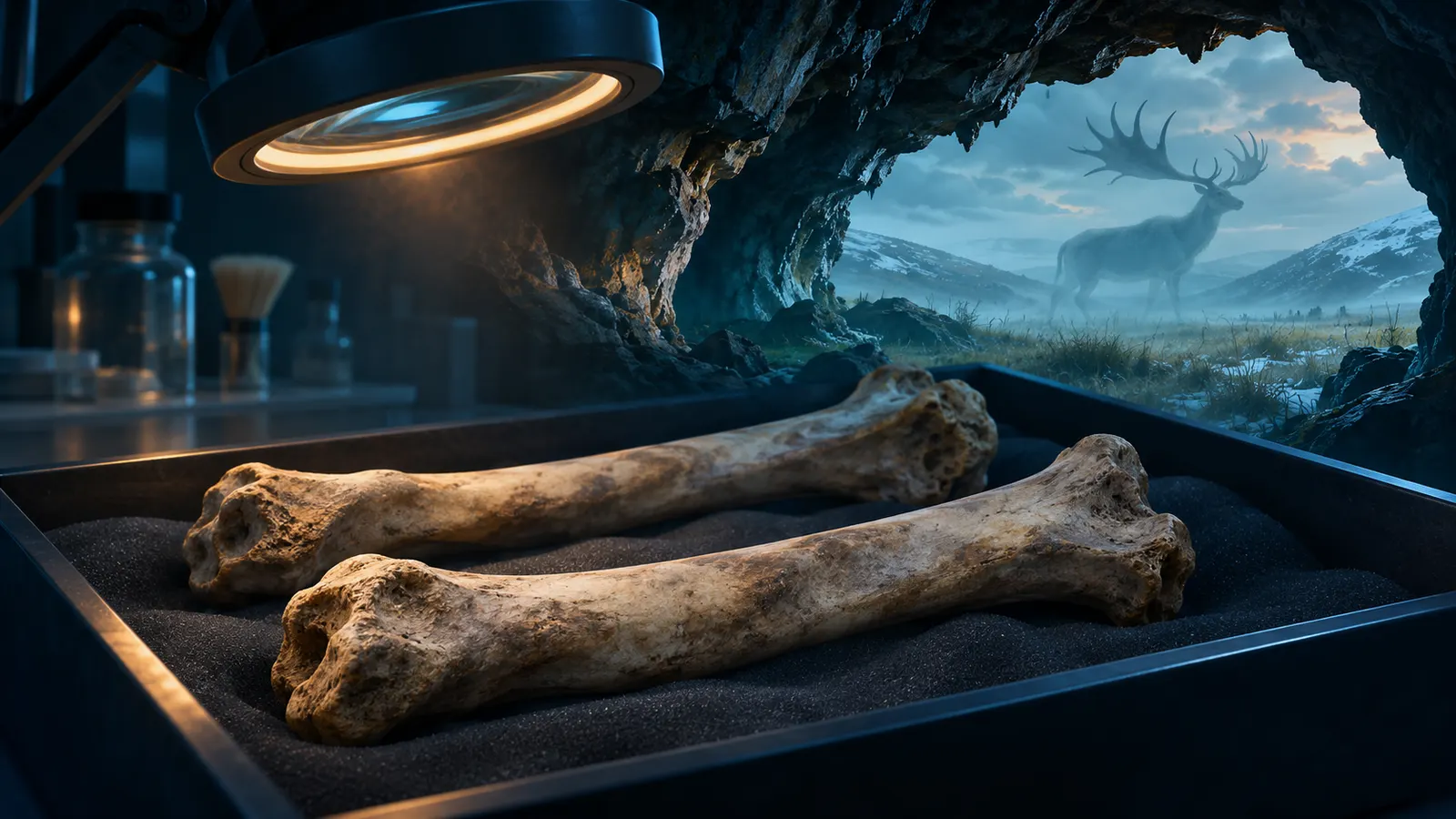
Two giant-deer bones from an Irish cave may show human butchery around 13,500 years ago. If confirmed, they would move Ireland’s earliest known human activity back by nearly a millennium. [1][2]
A possible mark from 13,500 years ago
Researchers re-examined bones collected at Ballynamintra Cave in the 1870s alongside new excavations. One lower-leg bone has a possible percussion impact and fresh-bone fractures; radiocarbon dating placed it between 13,573 and 13,321 years ago. A second bone carries possible chopping damage. [1][2]
Earlier than Ireland’s firm record
The earliest firm pre-Mesolithic evidence in Ireland is currently a butchered brown-bear bone dated to roughly 12,800–12,600 years ago. The new date fits hunter-gatherer activity elsewhere in north-west Europe, but timing cannot identify who altered these bones. [1][2]
What to keep in mind
Weathering erased microscopic tool striations, and no associated artefact confirms human action. The paper was accepted after anonymous review, but its publisher still labels the available advance-access version a preprint; the final version has not launched. [2]
Sources & context
Numbered references link the explanation to its sources. Hypothetical examples and visual metaphors are labelled in the text. Checked 28 November 2026.
- [1] Liverpool John Moores University — ‘Butchered’ animal bones discovery pushes human arrival in Ireland back 1,000 years (26 November 2026)
- [2] Jennings et al. — Ballynamintra Cave, Co. Waterford: A Window into Late Glacial Ireland and Possible Upper Palaeolithic Human Butchery at c. 13.5 ka cal BP, Proceedings of the Royal Irish Academy (accepted 26 June; advance-access preprint published 5 October 2026)
KEEP EXPLORING
 Burned Bones Can Still Trace a Roman JourneyNewsroom · 1 min read
 The White Statue May Be the Faded VersionPeek · 1 min read
 Roman Concrete Had More Than One Way to EndureExplore · 4 min read
CURIOUS MINDS, SHARED IDEAS
Join the conversation
What surprised you? Share a thought or a question.
Loading reader responses…