
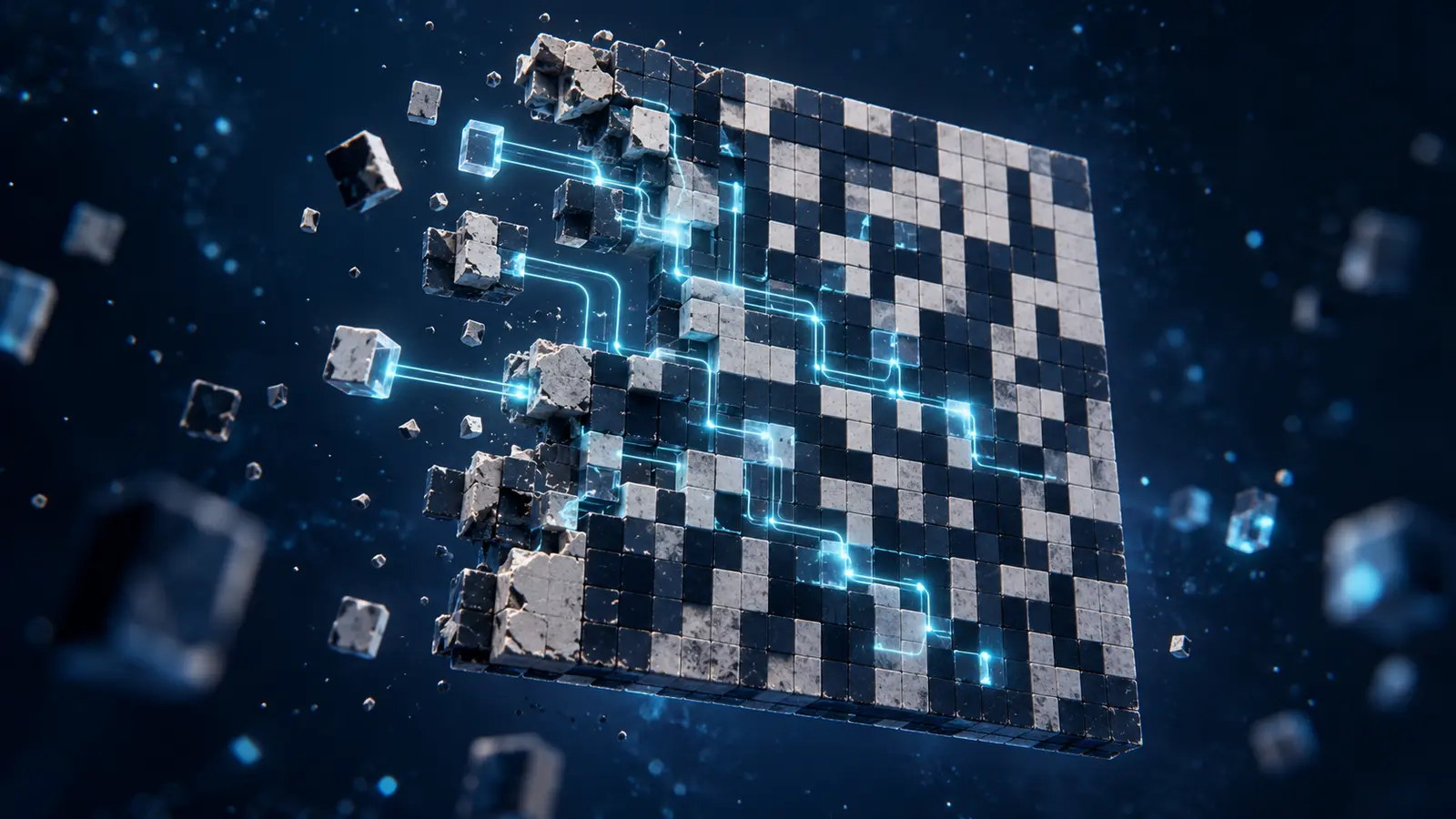
Scratch a QR code and your phone may still open the right page. The pattern is not merely a picture of the data: it also carries mathematical redundancy. A reader can use the surviving pieces to reconstruct information that was never captured correctly.
Missing data is part of the design
QR codes add Reed–Solomon error-correction codewords to the original payload. When some codewords are corrupted by dirt or damage, a scanner can use the added relationships to recover them. The four standard correction levels restore approximately 7, 15, 25 or 30 percent of total codewords. More protection also means more encoded material, so the symbol may need more space. [1]
Thirty percent is not thirty percent of the picture
The percentages describe codewords, not a guaranteed area that you can cut away. Where the damage lands matters. A QR code also needs recognizable positioning features, adequate contrast and a blank margin four modules wide. Distortion or clutter around the symbol can defeat reading even when much of the black-and-white pattern remains visible. [2][3]
What to keep in mind
Successful recovery still depends on correction level, damage pattern, printing quality, camera and software. The highest nominal level does not guarantee that every code with 30 percent visible damage will scan.
Sources & context
Numbered references link the explanation to its sources. Hypothetical examples and visual metaphors are labelled in the text. Checked 20 October 2026.
- DENSO WAVE — QR Code Error Correction Feature
- DENSO WAVE — Point for Determining the QR Code Area
- DENSO WAVE — Examples of Problems Encountered in Reading a Code
KEEP EXPLORING
 Some Hessdalen Lights Appeared on RadarPeek · 1 min read
 Can a City Save Summer Heat for Winter?Explore · 4 min read
 A Robot Can Do the Task. Can It Do the Job?Newsroom · 3 min read
CURIOUS MINDS, SHARED IDEAS
Join the conversation
What surprised you? Share a thought or a question.
Loading reader responses…