
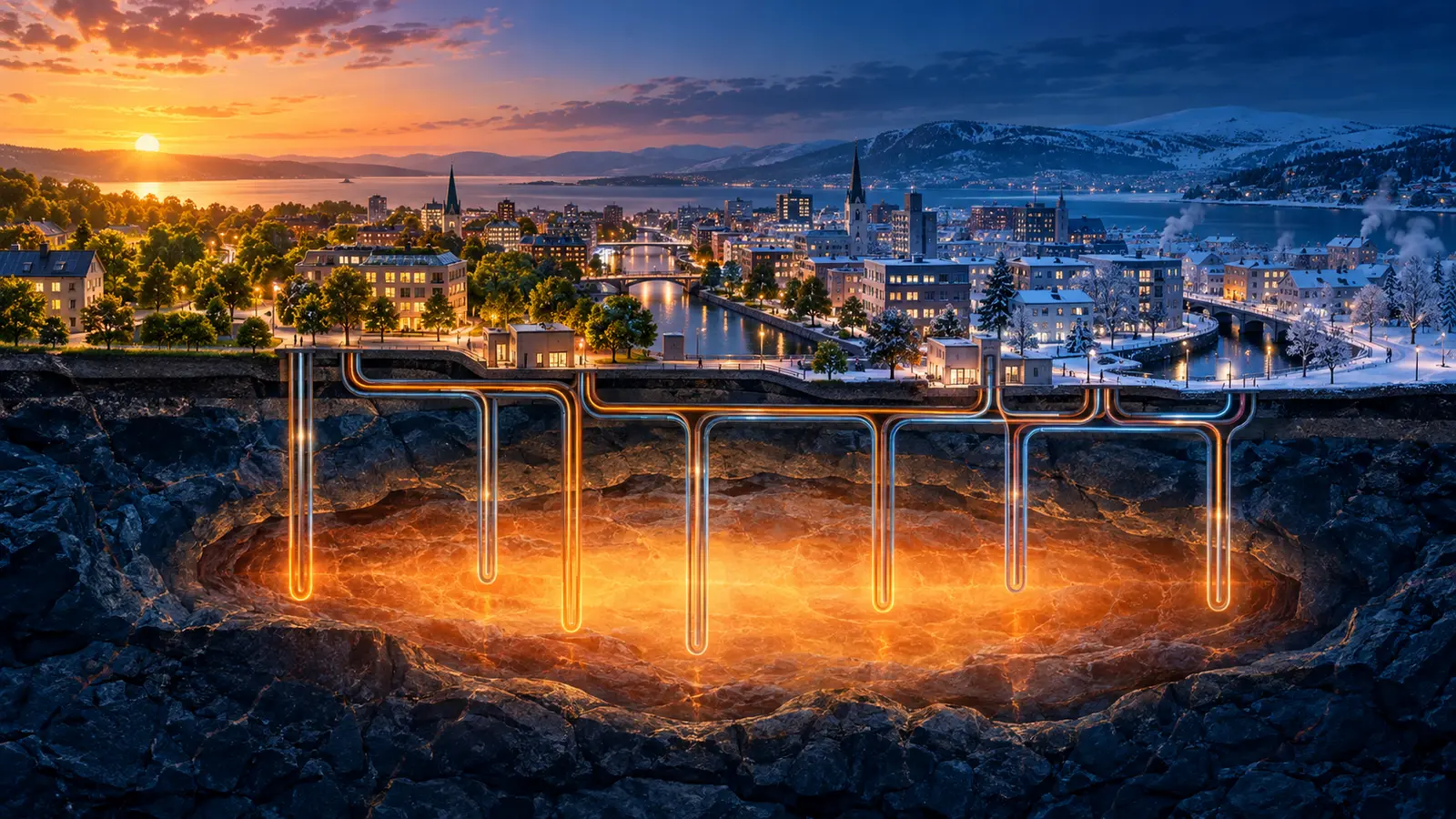
In July, a city may have more usable heat than it needs. By January, the same streets demand warmth every hour. What if part of summer could be parked underground and brought back months later? This is not a battery metaphor alone: seasonal thermal stores already use water, aquifers and rock as physical heat banks. [1][2]
Heat has a timing problem
Heat is energy, but turning it into electricity and back again is not always necessary. Buildings need warmth directly. Solar thermal systems and recovered heat can provide heat when demand is low, while district networks carry hot water from shared sources to homes and businesses. The International Energy Agency says such networks already serve about 600 million people worldwide, although many still depend heavily on fossil fuels. [2][3]
Thermal storage shifts supply through time. A system warms a large mass—water, groundwater or rock—then later moves that heat through pipes and heat exchangers. Insulation and the surrounding geology slow heat loss. The goal is not to preserve every joule; it is to recover useful temperatures when demand rises. [1][2]
Three ways to bank warmth underground
An aquifer thermal energy storage system uses wells in permeable rock. Groundwater carries heat into the aquifer and back out. It can provide cooling in summer as relatively cool groundwater absorbs building heat, then provide heating in winter when warmed water is recovered. [1]
Borehole storage uses a closed loop instead. Fluid circulates through pipes installed in drilled holes and exchanges heat with the surrounding bedrock, without pumping groundwater through the system. Reversing the seasonal flow retrieves part of the stored heat. Reservoir systems reach deeper formations, often using non-potable water or brine and targeting higher temperatures. [1]
The ground is therefore not automatically a free battery. Aquifers need suitable geology; boreholes require drilling and materials. The US Department of Energy identifies those installation costs as an important barrier. Designs must match local ground conditions, temperature needs and heat sources. [1]
When a thermal store becomes city-sized
Other designs use immense insulated tanks or water-filled pits. An IEA research profile examined concepts as large as 2 million cubic metres—about 800 Olympic swimming pools—for urban district heating. At that scale, a store could accept solar or recovered heat when it is plentiful and release it over a season. [2]
But size creates civil-engineering problems. Liners must remain watertight at elevated temperatures, the structure must fit into dense urban space, and its surface still has to be useful. The project explored placing sports fields or solar installations above buried stores. [2]
Storage may also ease pressure on the electricity grid. If heat is available from a thermal store during a peak period, buildings need less simultaneous electrical heating. DOE describes shifting heating and cooling demand away from peak electricity use as one benefit of underground storage. [1]
The demonstration that also became a warning
Drake Landing in Okotoks, Canada, showed what borehole storage could achieve. The Natural Resources Canada–conceived project linked 52 detached homes to solar district heating. More than 90 percent of their space-heating needs were supplied by solar thermal energy, with summer heat stored underground. The system began operating in 2007 and was monitored for nearly 17 years. [4]
Its later history matters just as much. Deterioration appeared from 2020, repairs became difficult, and parts and expertise grew harder to obtain. The required reinvestment was judged unaffordable; decommissioning began in 2024, and most homes returned to gas furnaces. [4]
That does not erase the performance milestone. It changes the design question. A seasonal store must be judged not only by how much heat it can move between seasons, but by whether owners can maintain, repair and finance it for decades.
What to keep in mind
Seasonal thermal storage is not lossless, universally suitable or automatically low-carbon. Performance depends on geology, temperatures, insulation, drilling, heat sources, network design, maintenance and backup. Drake Landing was one pioneering neighbourhood, while the largest city-scale concepts remain projects rather than universal templates. [1][2][4]
Sources & context
Numbered references link the explanation to its sources. Hypothetical examples and visual metaphors are labelled in the text. Checked 8 October 2026.
- U.S. Department of Energy — Geothermal Energy Storage
- International Energy Agency — Very large thermal energy storage for renewable districts (22 October 2021)
- International Energy Agency — Renewables in District Energy (10 June 2026)
- Town of Okotoks — Drake Landing Solar Community (updated 8 October 2024)
KEEP EXPLORING
 A Martian Rock Can Remember More Than One Kind of WaterNewsroom · 3 min read
 Bath Wrinkles Begin Beneath the SkinPeek · 1 min read
 Why a Viking Dig Can Keep Answering Questions for 50 YearsExplore · 3 min read
CURIOUS MINDS, SHARED IDEAS
Join the conversation
What surprised you? Share a thought or a question.
Loading reader responses…