
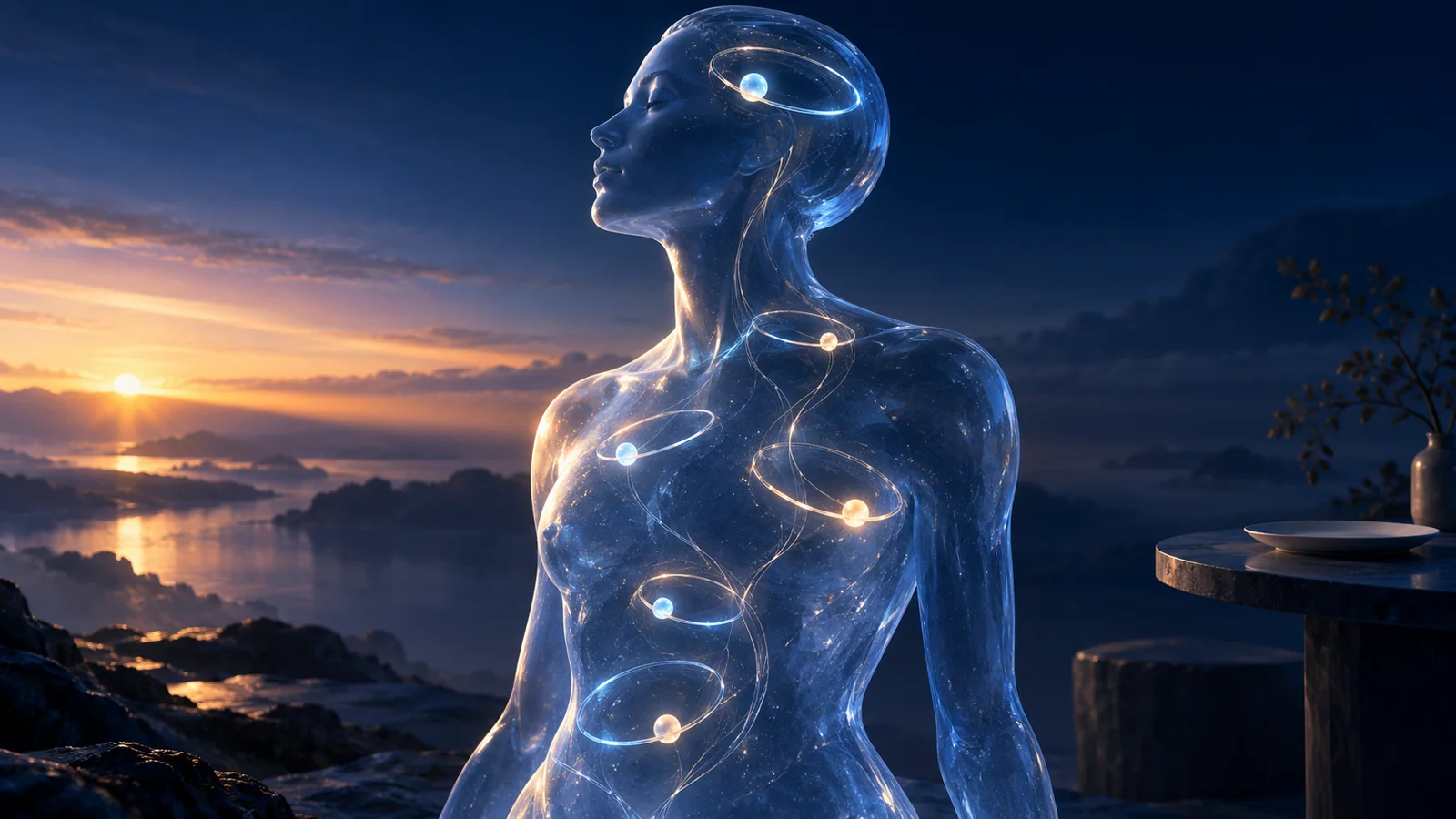
Imagine changing dinner time while leaving bedtime alone. Would every clock in your body move together? Think of timekeeping as a coordination problem: the fascinating question is whether changing one daily signal makes the whole system follow, or only parts of it.
A timekeeper in almost every tissue
Imagine a city whose railway station, bakeries and power plants all follow daily schedules. One central signal helps coordinate them, but each place has work of its own. That is a useful picture of biological timekeeping, provided we remember that the body contains cells, not tiny people checking watches.
In humans, nearly every tissue and organ has a circadian rhythm. These roughly daily patterns affect sleep, hormone release, digestion and body temperature. A brain structure called the suprachiasmatic nucleus, or SCN, helps synchronize the clocks across the body. [1]
The clock is chemistry
There are no hidden gears. Biological clocks involve genes and proteins operating in feedback loops: instructions produce proteins, and changing protein levels influence the activity of those instructions. Repeating molecular processes provide the timing machinery. These clocks continue working while we sleep. [2]
Picture a repeating sequence that carries its own delay. This is only an analogy, but it changes the question from where the clock is stored to how a process keeps returning to the same stage. A biological clock is something cells do.
A meal can move some rhythms
In a peer-reviewed 2017 laboratory study, ten healthy young men ate three daily meals five hours later than before. Researchers then measured selected rhythms under controlled conditions that removed ordinary sleep and environmental cycles. [3]
Later meals delayed the blood-glucose rhythm by about 5.7 hours and PER2 gene-expression timing in fat tissue by about one hour. Melatonin and cortisol rhythms, used as master-clock markers, did not significantly change. Neither did rhythms of subjective sleepiness. [3]
The contrast is the discovery: one changed schedule produced different responses across the measured system. That supports the idea that meal timing can influence some peripheral rhythms differently from master-clock markers. [3]
What time does your body think it is?
Light and darkness are major timing cues, while food intake and other signals also influence circadian rhythms. Travel across time zones and shift work can disrupt alignment with the outside day. [1]
Imagine landing somewhere that calls the next meal breakfast while your old schedule would call it dinner. The useful question becomes which signals your different clocks are receiving. A wall clock gives one answer immediately; the biological system has to coordinate several ongoing processes. This picture helps explain why internal time is richer than the number displayed on a phone.
What to keep in mind
This small, short study tested healthy young men and selected rhythms, not every organ or long-term health outcomes. Hormones were indirect master-clock markers. It establishes neither an ideal meal schedule nor a jet-lag treatment. The city and repeating-sequence comparisons are metaphors. [3]
Sources & context
Numbered references link the explanation to its sources. Hypothetical examples and visual metaphors are labelled in the text. Checked 5 October 2026.
- NIGMS — Circadian Rhythms (educational fact sheet; content reviewed September 2023)
- NIGMS — 4 Timely Facts About Our Biological Clocks (archived, 31 October 2014)
- Wehrens et al. — Meal Timing Regulates the Human Circadian System, Current Biology (2017; peer-reviewed original study, University of Surrey repository)
KEEP EXPLORING
 A Neanderthal Inheritance With a Small Modern EffectPeek · 1 min read
 Helping Cells Read Past a Premature Stop SignalNewsroom · 1 min read
 Roman Concrete Had More Than One Way to EndureExplore · 4 min read
CURIOUS MINDS, SHARED IDEAS
Join the conversation
What surprised you? Share a thought or a question.
Loading reader responses…