
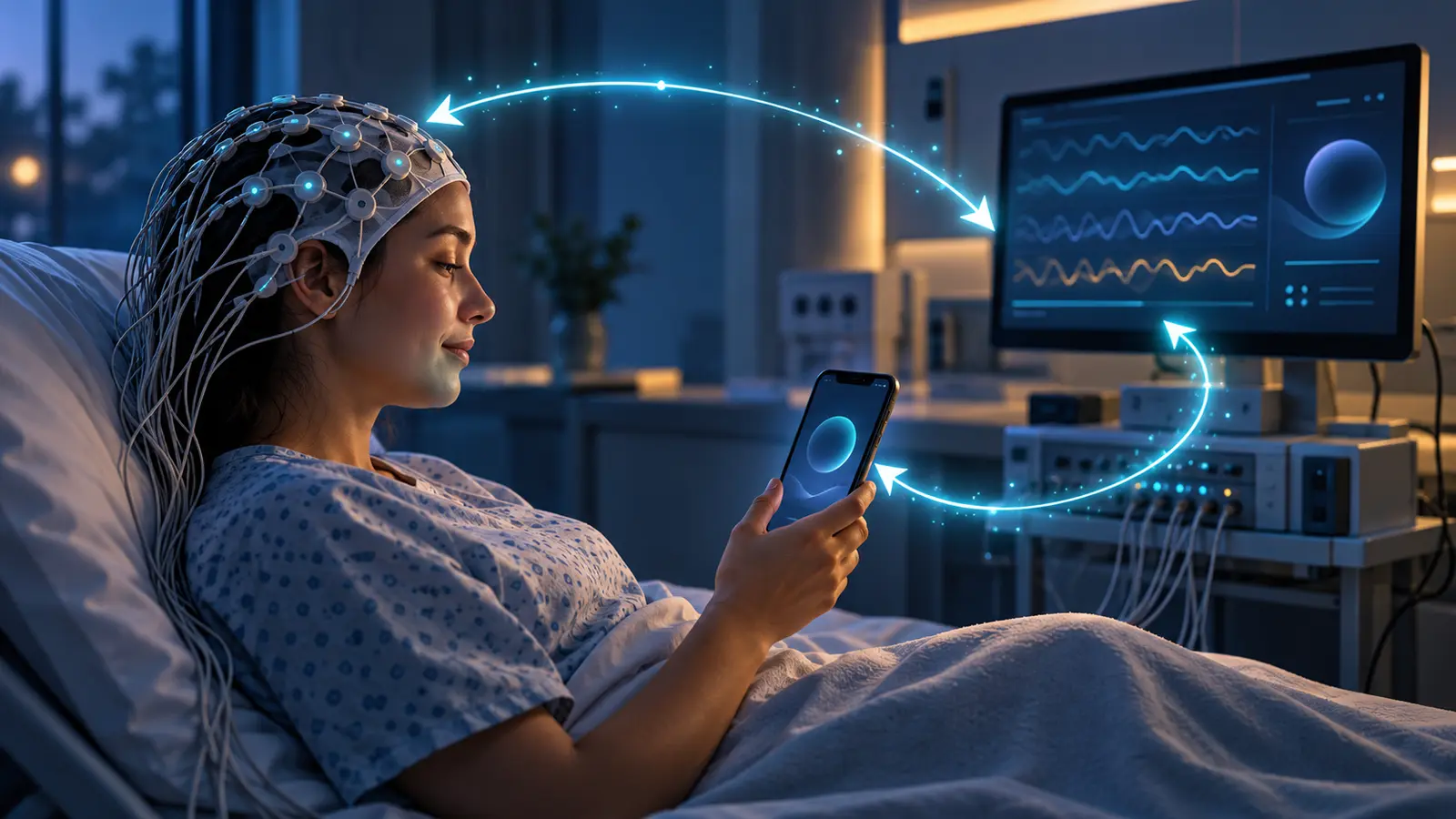
A seizure detector can flag electrical patterns, but it cannot know how every alert felt to the person wearing it. In a new hospital study, patients became part of the feedback loop.
The patient corrected the detector
Researchers linked real-time EEG monitoring to a smartphone interface for 13 adults in an epilepsy unit. Patients could ask about their data and label seizure alerts as true, false or uncertain. The detector then learned from that feedback; across the study, its false-alarm rate fell by about 80%. The peer-reviewed research appeared in Nature Medicine on 13 October 2026. [1][2]
A prototype, not home care
This was a prospective, single-center proof of concept conducted during hospital monitoring. The detector improvement was evaluated in a pseudoprospective simulation, and staff reviewed the system daily. It has not yet been shown to improve seizure control or work safely at home. [1]
What to keep in mind
The study included 13 English-speaking adults at one hospital and was designed for feasibility, not population-level effectiveness. Larger outpatient trials are needed.
Sources & context
Numbered references link the explanation to its sources. Hypothetical examples and visual metaphors are labelled in the text. Checked 21 October 2026.
- Goldblum, Shi et al. — Human–artificial intelligence collaboration for comanaging epilepsy in real time (Nature Medicine, 13 October 2026)
- NIH — Patients engage with epilepsy monitor in real time, improving seizure detection (13 October 2026)
KEEP EXPLORING
 Did Diving Help Shape the Body That Later Ran?Explore · 3 min read
 The Bayeux Story Is Also a Story About CopiesPeek · 1 min read
 A Martian Rock Can Remember More Than One Kind of WaterNewsroom · 3 min read
CURIOUS MINDS, SHARED IDEAS
Join the conversation
What surprised you? Share a thought or a question.
Loading reader responses…