
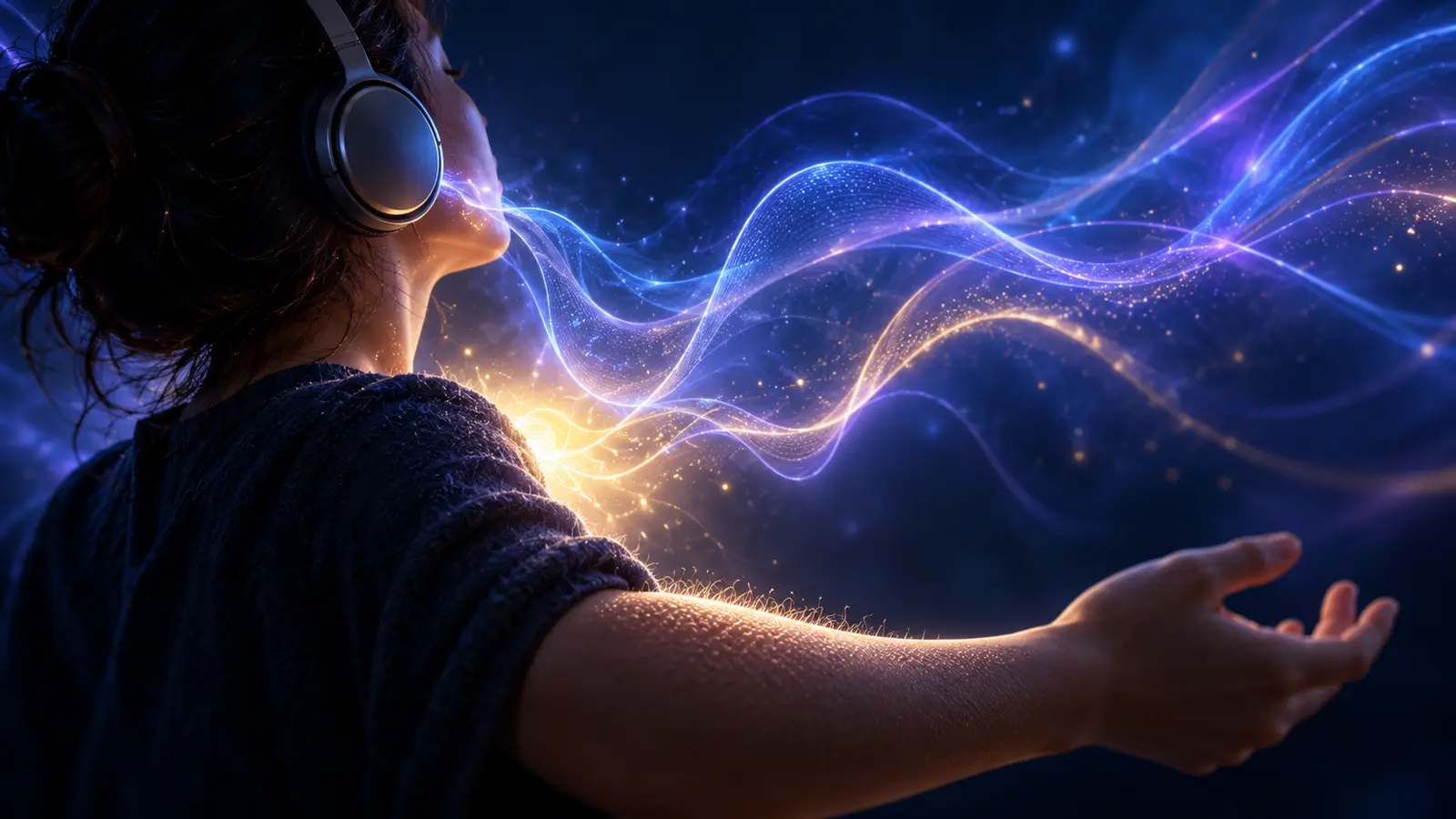
A chord resolves, a voice enters, and your skin suddenly ripples. Nothing touched you and the room did not get colder. Music has recruited an ancient body response for an abstract emotional event.
The skin uses old hardware
Goosebumps are piloerection. Tiny arrector pili muscles attached to hair follicles contract and pull the hairs upright. Sympathetic nerves drive the response. In furred animals, raised hair can trap insulating air; humans retain the machinery even though our sparse body hair provides little warmth. Cold is not the only trigger. Emotional arousal can activate the same visible reflex, alongside changes in heart rate and skin conductance. A systematic review of 24 studies found abundant signs of short-lived sympathetic activation during emotional piloerection. [1][4]
Musical pleasure unfolds in two acts
The revealing clue is timing. In a PET and fMRI study of people who reliably experienced musical chills, dopamine-related activity was not uniform throughout a favorite passage. The caudate was more involved during anticipation, while the nucleus accumbens was more involved at the emotional peak. [2] That division helps explain why the seconds before a favorite musical moment can matter almost as much as its arrival. The researchers’ measurements support a sequence: reward-related activity builds before the peak, then shifts as the intense pleasure is experienced. A chill can be the bodily marker of that transition from wanting the moment to receiving it.
Dopamine is part of the mechanism
Brain scans show association, but a later experiment tested dopamine more directly. Twenty-seven healthy participants listened to music after receiving, in separate double-blind sessions, a dopamine precursor, a dopamine-blocking drug, or a placebo. Increasing dopamine availability strengthened reported pleasure and motivation; reducing it pushed those measures in the opposite direction. The time participants reported chills changed in the same direction. [3] This does not mean dopamine is a simple pleasure chemical or that one molecule explains the entire experience. It shows that dopamine transmission contributes causally to how rewarding music can feel.
Your song may leave someone else cold
Your response also depends on your brain’s state before the first note. In a 2024 fMRI study of 49 people, connectivity between auditory and reward networks immediately before listening predicted the reported duration of chills as well as physiological and neural measures during the experience. The model generalized to a separate dataset for this pre-listening state, but not for a person’s more stable resting connectivity. [5] Early studies also used self-selected music and deliberately recruited reliable chill responders. There is no universal acoustic switch that guarantees goosebumps in every listener.
What to keep in mind
Researchers can measure piloerection, skin conductance, heart rate, brain activity, and reported chills, but these signals do not identify one universal cause. Several influential studies used small or selected samples, and the evolutionary reason emotional chills persist in humans remains unsettled.
Sources & context
Numbered references link the explanation to its sources. Hypothetical examples and visual metaphors are labelled in the text. Checked 2 November 2026.
- NIH — What goosebumps are
- Salimpoor et al. — Anatomically distinct dopamine release during anticipation and peak emotion to music, Nature Neuroscience (2011)
- Ferreri et al. — Dopamine modulates the reward experiences elicited by music, PNAS (2019)
- McPhetres and Zickfeld — The physiological study of emotional piloerection, systematic review (2022)
- Mori and Zatorre — State-dependent connectivity predicts musical chills, PLOS Biology (2024)
KEEP EXPLORING
 Why Can a Missing Limb Still Feel Present?Explore · 3 min read
 A New Brain Atlas Looks Beneath the DiagnosisNewsroom · 3 min read
 Does a Vivid Memory Have to Be True?Peek · 2 min read
CURIOUS MINDS, SHARED IDEAS
Join the conversation
What surprised you? Share a thought or a question.
Loading reader responses…