
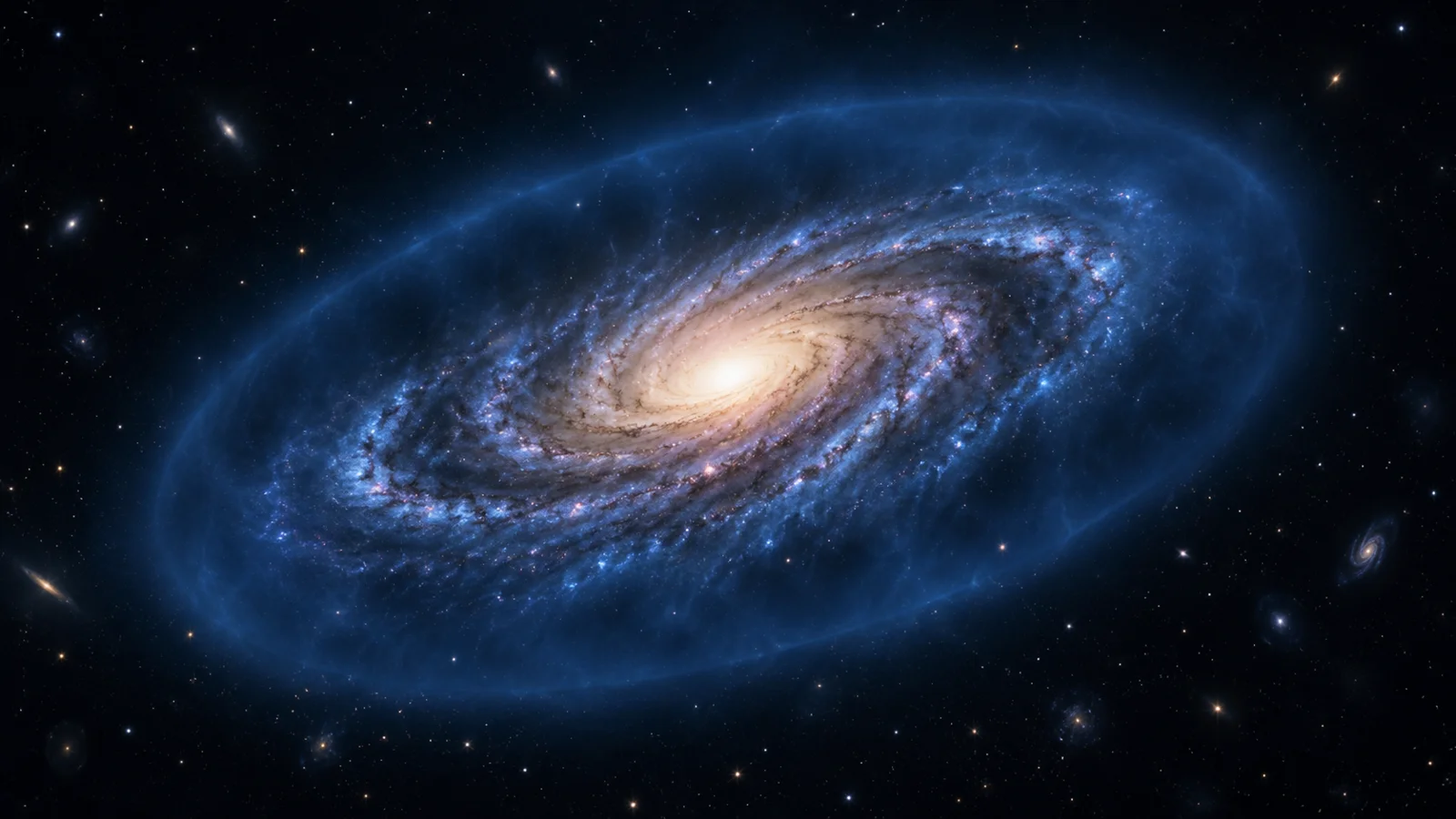
We can investigate how something changes a galaxy without knowing what it is made of. Dark matter is a remarkable example of that gap.
An effect is not an identity
NASA describes dark matter through its gravitational effects, including the behaviour of galaxies and the bending of light. Unlike ordinary luminous matter, it does not reveal itself to our telescopes in the familiar way. The name labels an inferred component of the universe; it is not the name of a particle researchers have already collected. [1]
Think of two questions on separate cards. One asks what gravitational influence the observations require. The other asks what physical entity supplies it. Answering the first does not automatically answer the second. Keeping the cards separate makes the mystery sharper, rather than weaker.
Turn a candidate into a test
Some experiments search for hypothetical particles called WIMPs: weakly interacting massive particles. LUX-ZEPLIN, or LZ, uses liquid xenon to look for the recoil of a xenon nucleus after a possible collision. A recoil produces light signals that can be measured. Additional detector layers help identify backgrounds that could otherwise be mistaken for the sought interaction. [2]
This is not a camera taking a photograph of dark matter. It is a test of a candidate's predicted behaviour. The interpretation depends on separating a possible signal from processes that can imitate it. A detector event becomes interesting because of its measured properties and the expected backgrounds, not because it looks mysterious.
An intriguing event needs context
LZ's September 2026 update reports a high-energy recoil event of interest and discusses its statistical significance. The collaboration does not announce a dark-matter discovery. Its public account distinguishes the significance of a particular feature from the significance after considering the wider search. [3]
That distinction matters whenever researchers inspect many possible places for a signal. An unusual feature found somewhere in a broad search needs different statistical context from a feature predicted in advance at one specific place. Curiosity is justified; a conclusion must wait for the evidence required by the claim.
What would move us forward?
The useful research question is therefore more precise than “Have we found something strange?” It is whether a measured pattern can withstand the background analysis and support a particular physical explanation. LZ's detector design and results show how that question can be turned into a measurable test. [2][3]
Different kinds of evidence also answer different parts of the puzzle. Astronomical observations investigate the gravitational role; a laboratory search tests an interaction model. Connecting those levels would be a much stronger result than simply giving an unexpected event the same name as a cosmic mystery. [1][2]
What to keep in mind
The particle identity remains unknown. WIMPs are candidates, not established ingredients. LZ's September 2026 event is discussed as a research result needing interpretation, not confirmation of dark matter. This article does not adjudicate competing gravity models.
Sources & context
Numbered references link the explanation to its sources. Hypothetical examples and visual metaphors are labelled in the text. Checked 6 October 2026.
- NASA Science: Dark Matter
- LZ collaboration: Detector and signal measurement
- LZ collaboration: September 2026 results
KEEP EXPLORING
 Webb Reads Collision Clues in Dust Around StarsNewsroom · 1 min read
 Where Is Everybody?Explore · 3 min read
 Stopping a Cavity Without Making It DisappearPeek · 1 min read
CURIOUS MINDS, SHARED IDEAS
Join the conversation
What surprised you? Share a thought or a question.
Loading reader responses…