

Look at a clear night sky and imagine that some of those stars have worlds of their own. Now add time: enough for civilizations to emerge, develop technology and perhaps travel. Why does the sky still seem so quiet?
The tension behind the question
The Fermi paradox compares the possibility of numerous long-lived technological civilizations with the lack of an obvious, confirmed presence. If some civilizations expanded widely, why do we not see unmistakable signs? The argument depends on assumptions about how often intelligence emerges and what civilizations do afterwards. [1]
A galaxy full of planets is not automatically a galaxy full of engineers. The steps from a suitable environment to life, from life to intelligence and from intelligence to detectable technology are separate questions.
A quiet sky has several possible explanations
Intelligent life might be rare. Expansion across stars might be difficult or unattractive. Technological societies might remain detectable only briefly. Or there might be evidence we have not yet found. These are proposed explanations, not established answers. [1]
Imagine two people sending messages from opposite sides of a huge landscape. They need more than the ability to transmit: their signals must reach the right place, at the right time, in a form the other recognises. This analogy illustrates why existence and detection are different problems.
What have we actually listened for?
SETI searches target evidence of technology, often using radio telescopes. Their sensitivity, observing time, frequencies and target choices determine what they can detect. The SETI Institute's Technosearch archive records search parameters across published projects, including radio and optical searches. There is no single experiment that has checked every possible signal. [2][3]
A null result matters within the limits of that search. It can tell us that a particular kind of detectable signal was absent from the observations. It cannot by itself tell us that no civilization exists anywhere.
The most useful response to the paradox may therefore be a better experiment: more clearly defined targets, improved instruments and transparent records of what has actually been tested.
What to keep in mind
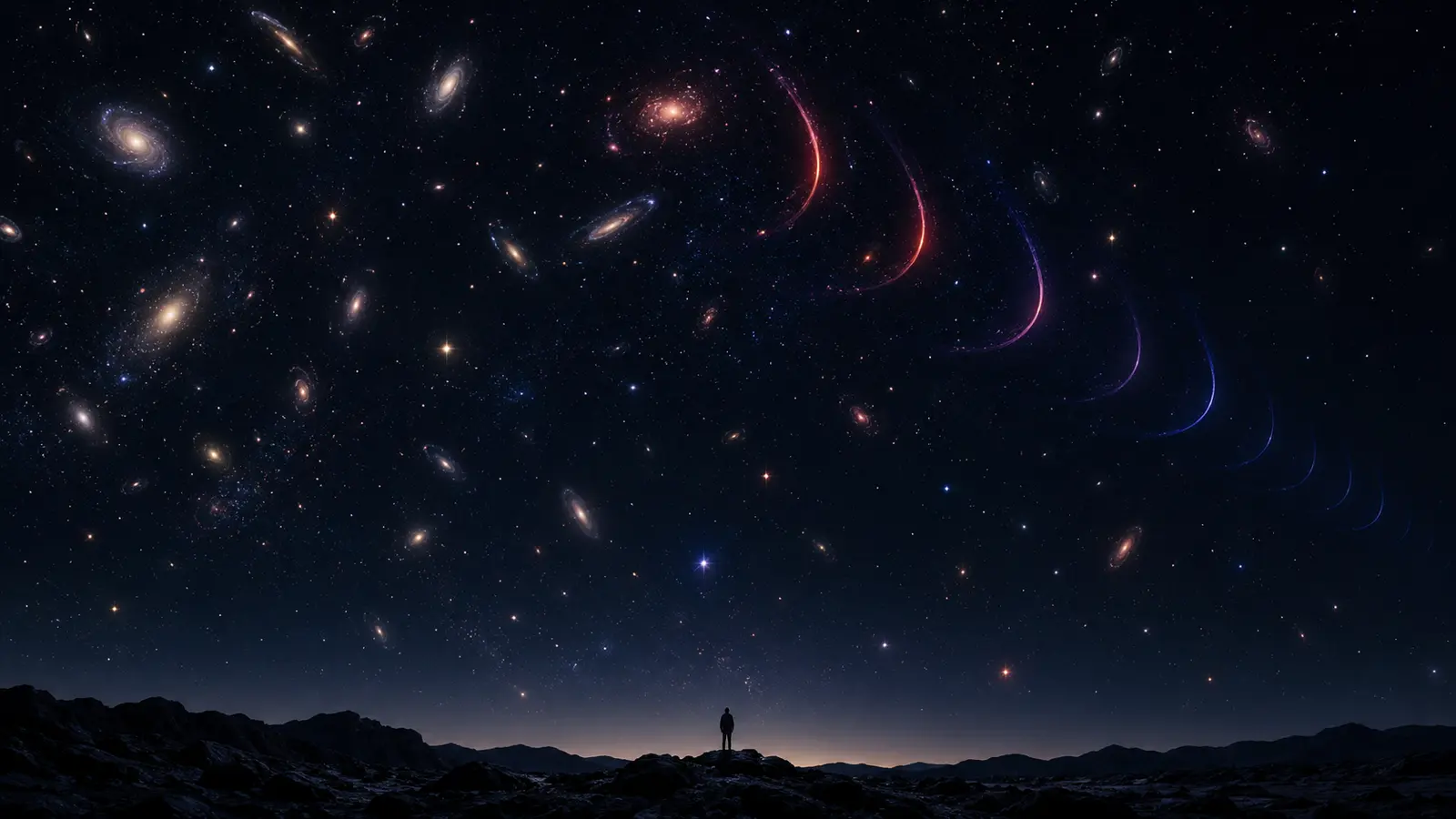
The proposed solutions remain hypotheses. The illustration does not measure the fraction of space searched, and the article makes no claim that one explanation has solved the paradox.
Sources & context
Numbered references link the explanation to its sources. Hypothetical examples and visual metaphors are labelled in the text. Checked 2 October 2026.
- SETI Institute — The Fermi Paradox
- SETI Institute — Frequently Asked Questions
- SETI Institute — Technosearch
KEEP EXPLORING
 The Dark Sky Is a Cosmic CluePeek · 1 min read
 How One Galaxy Can Appear Several TimesExplore · 3 min read
 Heavy Methanol Exposes a Gap in Space ChemistryNewsroom · 1 min read
CURIOUS MINDS, SHARED IDEAS
Join the conversation
What surprised you? Share a thought or a question.
Loading reader responses…