
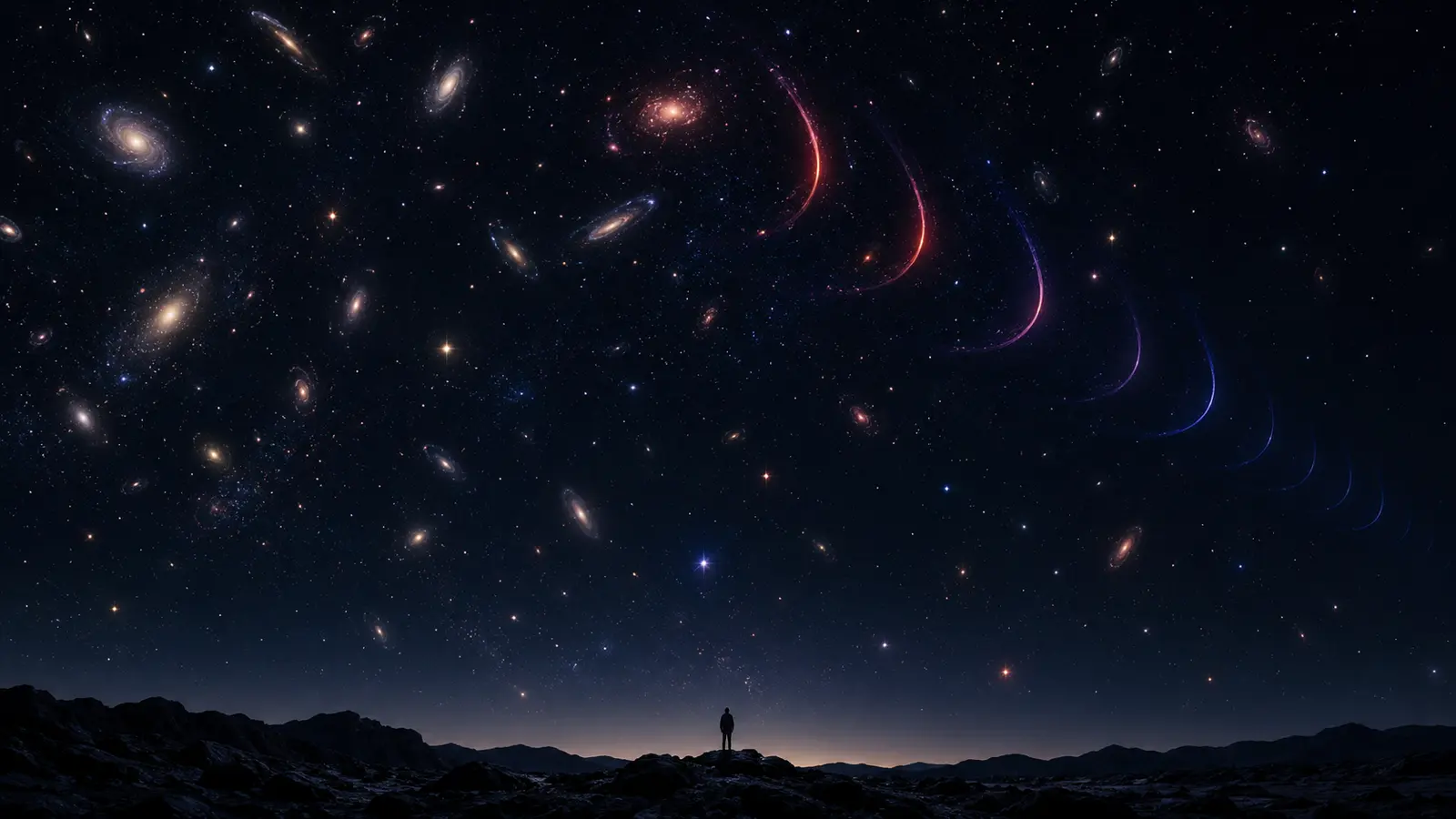
The empty-looking spaces between stars carry a message. If the universe were static, infinitely old and filled with stars, every direction should eventually end on a shining surface. The whole night sky ought to glow. It does not. This puzzle is called Olbers’ paradox. [1]
Darkness sets a limit
The universe has not existed forever: NASA places its early expansion about 13.8 billion years ago. Light therefore has had a limited time to reach us. Expansion also stretches light from very distant galaxies toward longer wavelengths, moving some of it beyond what human eyes can see. [1][2]
The unseen sky is not empty
NASA describes the cosmic microwave background as the oldest light we can observe. Telescopes detect this ancient glow at microwave wavelengths, even though our eyes register darkness. [1][2]
What to keep in mind
This is a compact explanation, not a standalone measurement of the universe’s age or a complete account of every source of sky brightness. The illustration’s colored arcs are metaphorical, not measured radiation.
Sources & context
Numbered references link the explanation to its sources. Hypothetical examples and visual metaphors are labelled in the text. Checked 6 October 2026.
- NASA Night Sky Network — Looking Beyond the Stars (1 September 2023)
- NASA Science — The Universe’s History (updated 12 August 2026)
KEEP EXPLORING
 How One Galaxy Can Appear Several TimesExplore · 3 min read
 A Flash From Space That Lasts Just MillisecondsPeek · 1 min read
 Heavy Methanol Exposes a Gap in Space ChemistryNewsroom · 1 min read
CURIOUS MINDS, SHARED IDEAS
Join the conversation
What surprised you? Share a thought or a question.
Loading reader responses…