
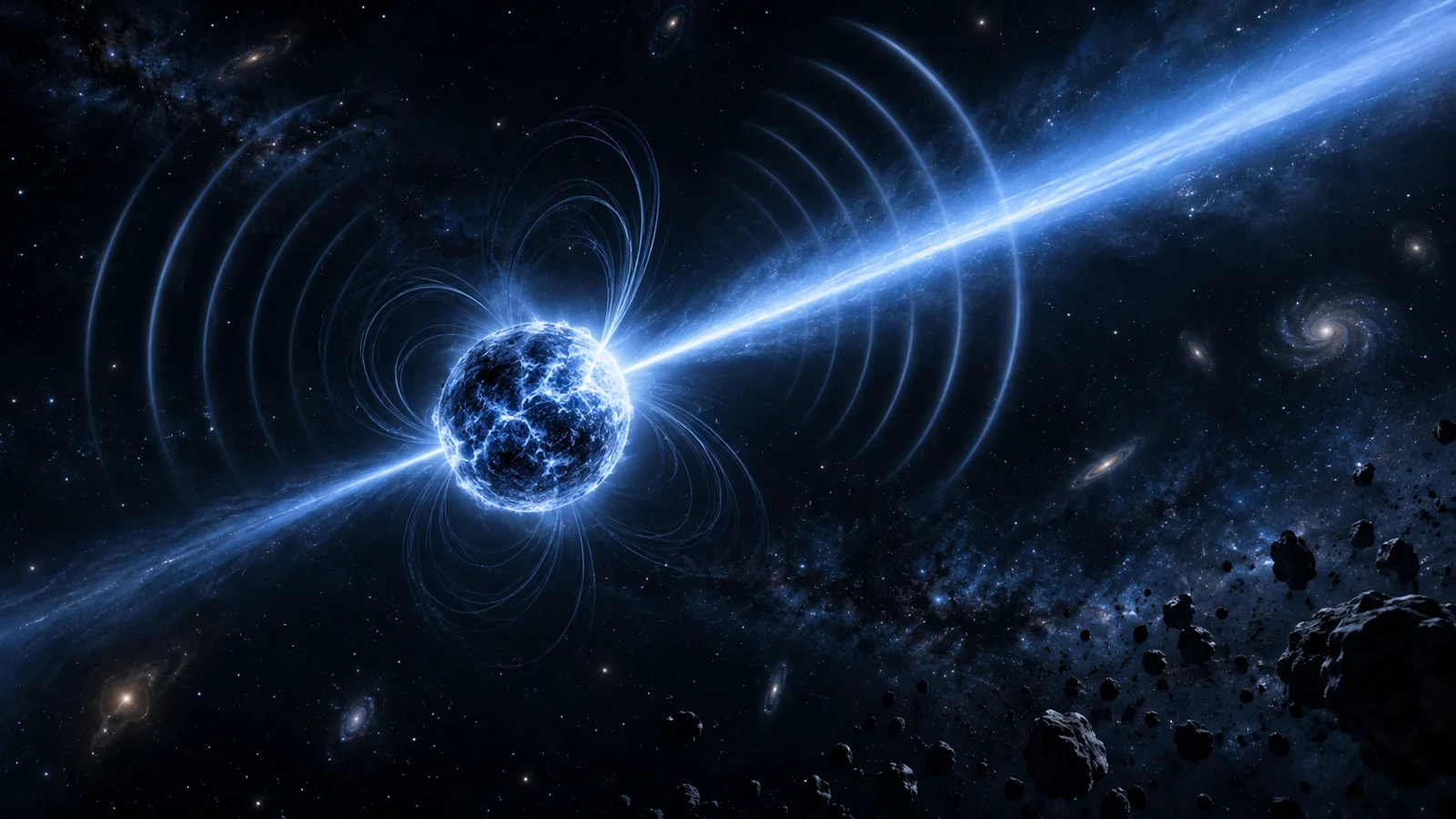
A signal can disappear almost immediately and still carry information about a journey across the universe.
A short signal, a major clue
Fast radio bursts are extremely brief radio flashes. In 2020, a burst associated with the Milky Way magnetar SGR 1935+2154 connected this kind of emission to an intensely magnetic neutron star. NASA's account describes radio and X-ray observations that helped identify the source. This provides evidence for magnetars as producers of FRB-like bursts; it does not establish that every burst has the same origin. [1]
The journey is part of the message
ESO explains another use for these flashes: radio frequencies are delayed differently as the signal crosses ionized material. That dispersion lets astronomers investigate matter along the route, including material between galaxies. A puzzling cosmic flash can therefore become a probe of otherwise difficult-to-measure gas. [2]
What to keep in mind
Magnetar evidence does not settle all emission mechanisms or every FRB population. The cited discoveries date to 2020 and 2023; this is an explainer, not breaking news.
Sources & context
Numbered references link the explanation to its sources. Hypothetical examples and visual metaphors are labelled in the text. Checked 6 October 2026.
- NASA: Pinpointing an X-ray and radio burst from a magnetar
- ESO: A distant FRB and its use as a probe, October 2023
KEEP EXPLORING
 The Dark Sky Is a Cosmic CluePeek · 1 min read
 Heavy Methanol Exposes a Gap in Space ChemistryNewsroom · 1 min read
 How One Galaxy Can Appear Several TimesExplore · 3 min read
CURIOUS MINDS, SHARED IDEAS
Join the conversation
What surprised you? Share a thought or a question.
Loading reader responses…