
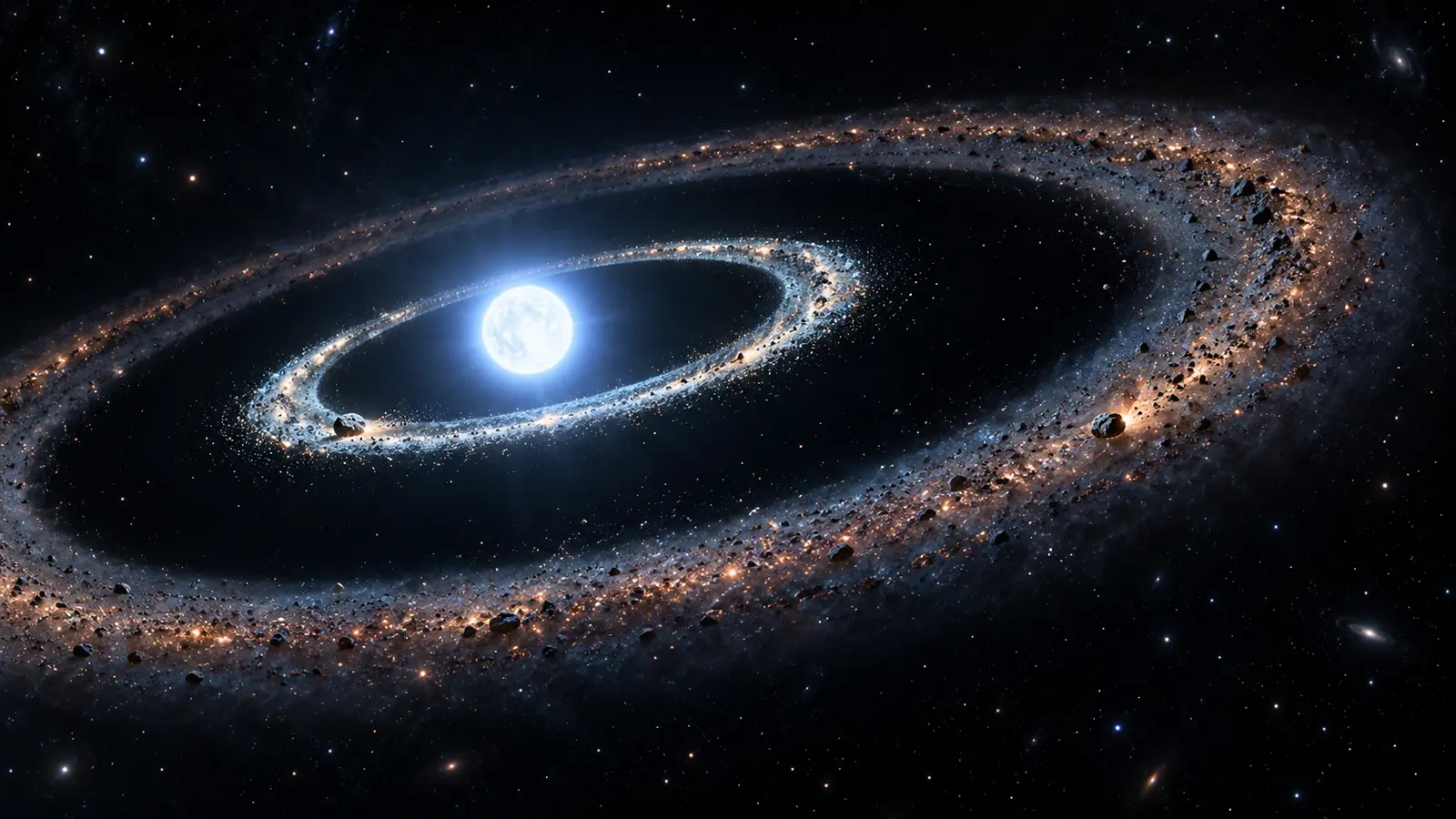
A white dwarf has revealed an unusual afterlife for a planetary system: two separate rings of vaporized rocky debris, divided by a persistent gap.
Four peaks, two rings
Using X-shooter on ESO’s Very Large Telescope, astronomers studied the white dwarf WD J1328−1450. Its calcium and oxygen emission lines had four peaks rather than the usual two. Modeling places the gas in two concentric rings, while magnesium appears mainly in the inner ring, indicating different compositions. The peer-reviewed Nature Astronomy paper was announced by ESO on 27 October 2026. [1][2][3]
Bodies may hold the gap open
The team argues that two surviving rocky bodies could replenish and confine the gas: an inner asteroid-scale object and an outer body potentially as large as Pluto or the Moon. These bodies were inferred from spectra and modeling, not directly seen. [1][2][3]
What to keep in mind
The two-body explanation is favored, not confirmed. A differently shaped single disc could mimic the signal, and the bodies’ sizes and orbits depend on model assumptions.
Sources & context
Numbered references link the explanation to its sources. Hypothetical examples and visual metaphors are labelled in the text. Checked 28 October 2026.
- Original peer-reviewed study: Gentile Fusillo et al. — A double debris disc around a white dwarf sculpted by two planetary bodies, Nature Astronomy (27 October 2026)
- European Southern Observatory — Dead star and planetary bodies: astronomers spot unique disc of debris (27 October 2026)
- Research paper PDF hosted by the European Southern Observatory
KEEP EXPLORING
 Webb Reads Collision Clues in Dust Around StarsNewsroom · 1 min read
 When Waste Plastic Becomes a Structural ShapePeek · 1 min read
 Why Does the Aurora Change Color?Explore · 3 min read
CURIOUS MINDS, SHARED IDEAS
Join the conversation
What surprised you? Share a thought or a question.
Loading reader responses…