
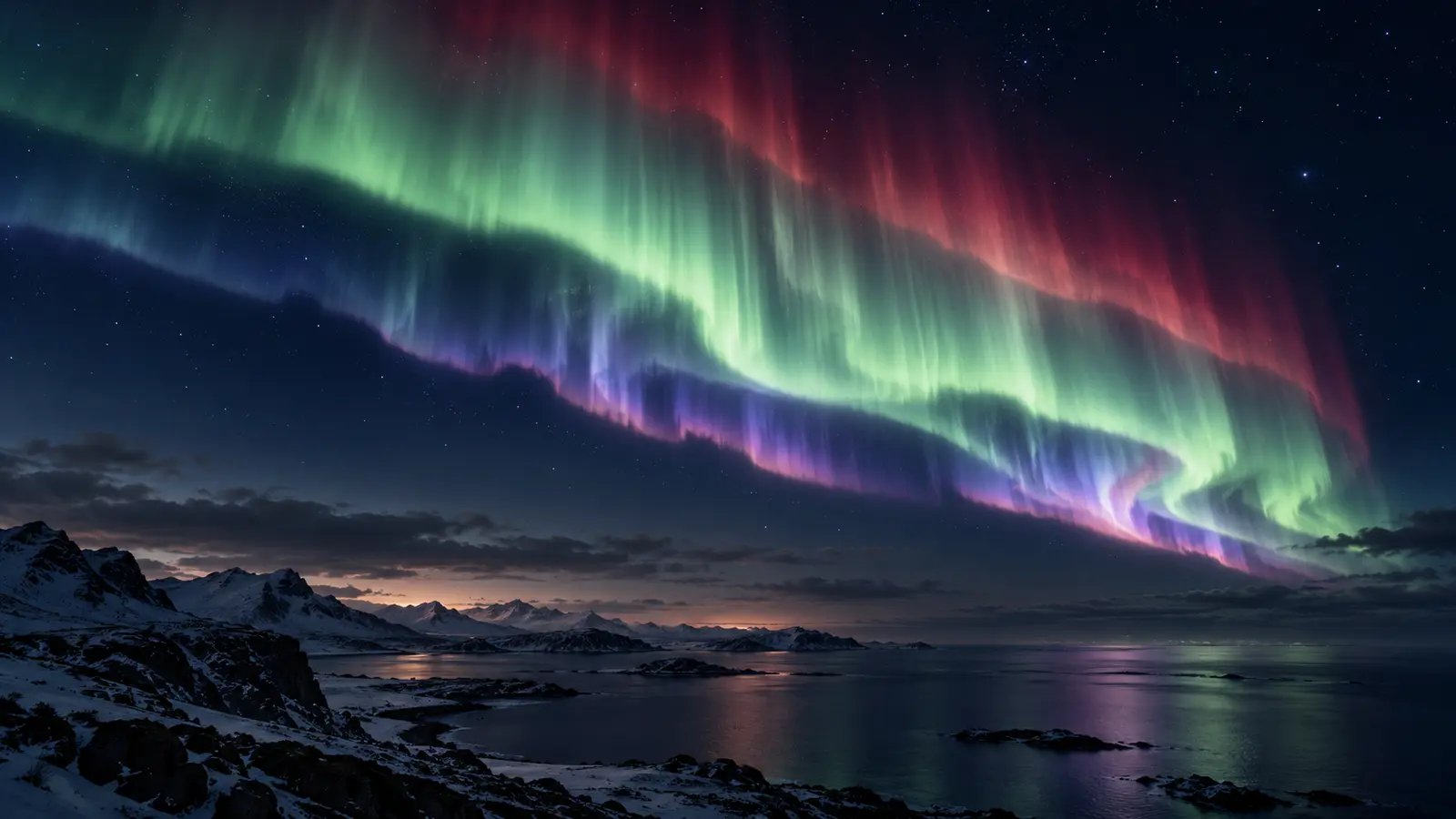
A green curtain can turn crimson at the top and violet along its lower edge. Those colors are not painted onto the sky by the Sun. They are produced locally, as Earth’s upper atmosphere converts particle energy into particular wavelengths of light.
A glow made on Earth
Aurora begins with a chain of energy transfers. The solar wind interacts with Earth’s magnetosphere, and under favorable magnetic conditions that interaction sends more energy into the system. Electrons already within the magnetosphere are accelerated along magnetic-field lines toward the polar atmosphere. There they collide with atoms and molecules, lifting them into excited energy states. When those states relax, they release photons—the light we see as aurora. This is why the glow usually forms an oval around each magnetic pole rather than appearing evenly across the planet. [1][2]
Oxygen has two visible clocks
Oxygen can shine in more than one color because an atom has more than one excited state. The familiar pale green line, centered near 557.7 nanometers, comes from one state of atomic oxygen. NASA places most green aurora roughly 100–200 kilometers above Earth, although NOAA describes a broader typical region extending higher. [1][2]
Red oxygen light comes from a different state that holds its energy much longer. NOAA gives that state a lifetime longer than 150 seconds. In dense air, collisions usually interrupt it before a red photon escapes; in the thinner upper atmosphere, the atom has time to radiate. That is why red often appears above the green curtain, with NASA’s broad guide placing it above about 200 kilometers. [1][2]
Nitrogen colors the lower edge
Lower down, molecular nitrogen becomes more important. Energetic particles that penetrate deeper can produce blue and pink emissions, and nitrogen can add a violet or purplish border beneath a green arc. Its relevant emissions occur quickly, so they can survive where the atmosphere is dense enough to quench oxygen’s slow red glow. Mixed emissions along the same line of sight can make the display look purple, pink, yellowish, or nearly white rather than like a set of separate colored bands. [1][2]
Why cameras see more
A photograph may show richer color than the observer remembers. In low light, human vision detects brightness more readily than hue, so a faint aurora may look pale or gray-green. Digital cameras can register colors that are too dim for the eye, and exposure, white balance, sensor response, haze, and city light can alter the recorded palette. The camera is not necessarily inventing the aurora; it is sampling the scene differently. [2]
A clue, not a storm meter
Color therefore carries information, but it is not a simple storm gauge. It can indicate which atmospheric species emitted light and the approximate altitude where that happened. Brightness and geographic reach depend on the wider geomagnetic event, while the visible mix also depends on particle energy, atmospheric density, viewing angle, and the sensitivity of the observer or camera. A red sky alone does not tell you exactly how powerful the solar disturbance was. [1][2]
What to keep in mind
Altitude bands are approximate and overlap. Color alone cannot uniquely determine particle energy, storm strength, or source conditions; spectroscopy and other measurements are needed for precise conclusions.
Sources & context
Numbered references link the explanation to its sources. Hypothetical examples and visual metaphors are labelled in the text. Checked 22 October 2026.
Our editorial principles · Suggest a correctionKEEP EXPLORING
 Can Light Turn Stored Heat Back Into Electricity?Explore · 3 min read
 The White Statue May Be the Faded VersionPeek · 1 min read
 A Dead Star’s Debris Split Into Two RingsNewsroom · 1 min read
CURIOUS MINDS, SHARED IDEAS
Join the conversation
What surprised you? Share a thought or a question.
Loading reader responses…