
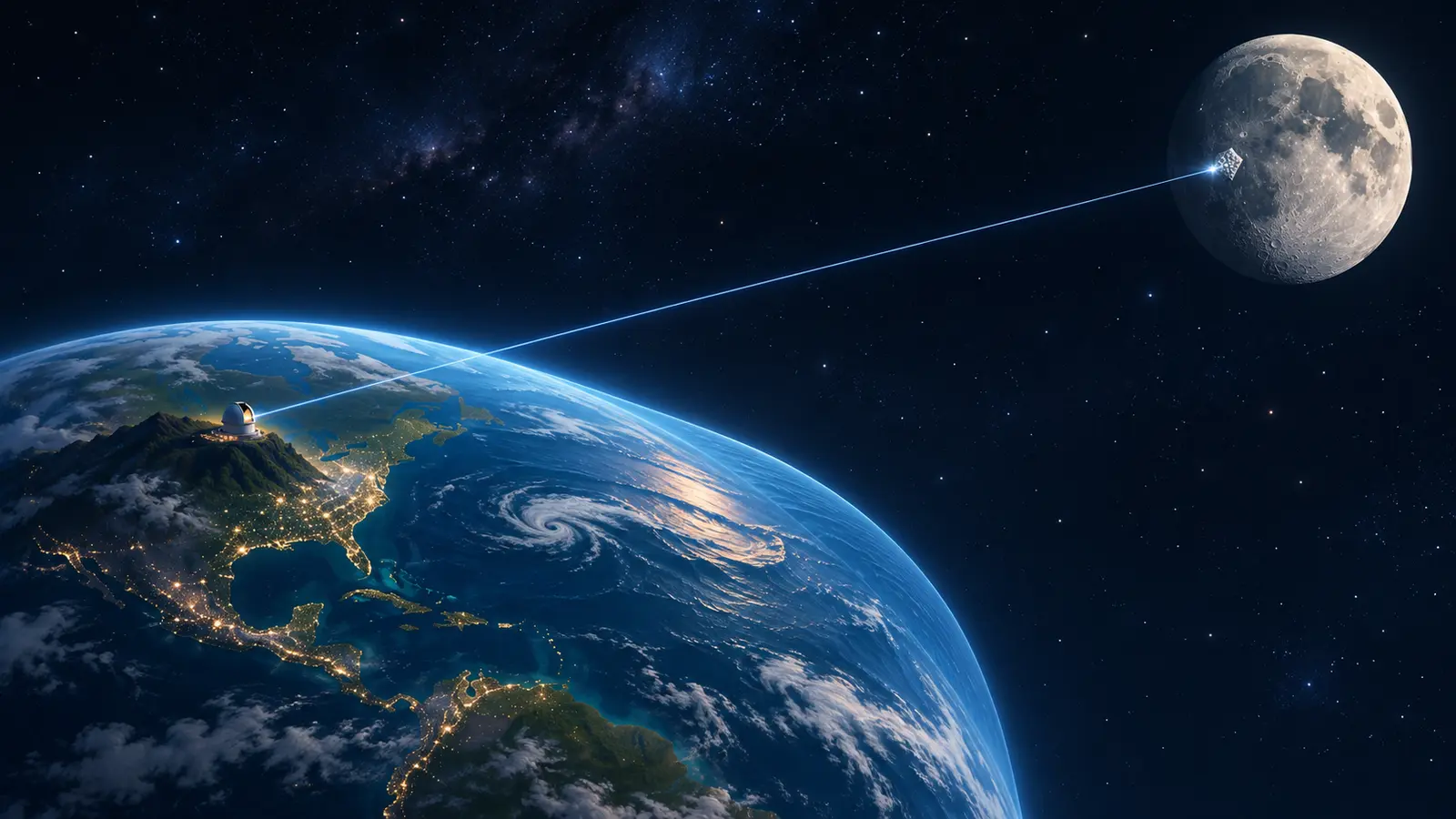
The Moon is not circling Earth at a fixed distance. Every year, it ends up about 3.8 centimeters farther away—and the missing energy comes partly from Earth’s spin.
A ruler made of light
Apollo astronauts left arrays of glass corner-cube reflectors on the lunar surface. Observatories fire laser pulses at them and time the returning light. Because the reflectors need no power, this experiment has continued for decades. Repeated measurements can determine the Earth–Moon distance to within millimeters and reveal the slow outward drift. [1][2]
The tide transfers spin
The mechanism begins with tides. Earth rotates faster than the Moon orbits, so the oceanic tidal bulge is carried slightly ahead of the line joining Earth and Moon. Its gravity pulls the Moon forward, raising it into a wider orbit. The Moon pulls back on that bulge, slowing Earth’s rotation. Angular momentum is not disappearing; it is moving from Earth’s spin into the Moon’s orbit. [1]
What to keep in mind
The 3.8-centimeter figure is the measured present-day average, not a fixed rate for all lunar history or the future. NASA notes that the drift slows as it continues; the Moon’s tilt, its elliptical orbit, Earth’s deep interior, and the Sun also create smaller changes. [3]
Sources & context
Numbered references link the explanation to its sources. Hypothetical examples and visual metaphors are labelled in the text. Checked 3 November 2026.
- NASA JPL — The Apollo Experiment That Keeps on Giving
- International Laser Ranging Service — Lunar Laser Ranging
- NASA Science — Tidal Locking
KEEP EXPLORING
 Your Skeleton Repairs Itself by Taking It ApartPeek · 1 min read
 Webb Reads Collision Clues in Dust Around StarsNewsroom · 1 min read
 What Would Count as Proof of Alien Life?Explore · 3 min read
CURIOUS MINDS, SHARED IDEAS
Join the conversation
What surprised you? Share a thought or a question.
Loading reader responses…