

Look up at the Moon. You are seeing something close to the present—but not quite the present.
A sky full of delays
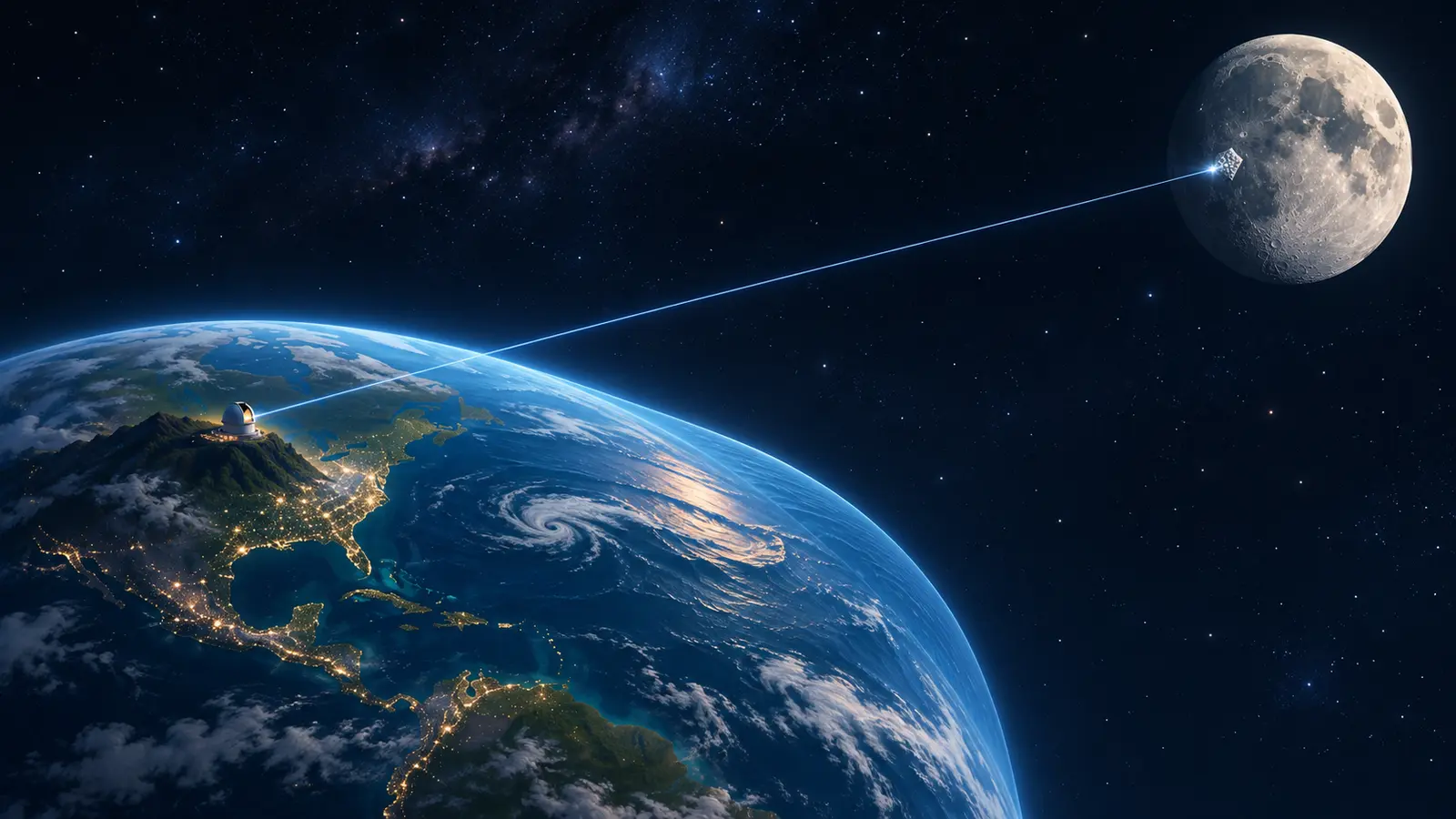
Light takes roughly 1.3 seconds to travel from the Moon to Earth. The sunlight reflected from its surface reaches you after that final leg of the journey. Your view therefore shows the Moon as it was a little earlier. [1]
Across a room, the delay is too small to notice. Across space, it becomes central to what astronomers can observe. A light-year measures distance: how far light travels in a year. Looking at an object whose light travelled for years means receiving an earlier view of it. [2]
A telescope with a time dimension
Webb studies distant galaxies through light that began its journey billions of years ago. That gives scientists evidence about earlier stages of the universe, rather than a live view of every galaxy at this instant. [1]
Imagine a night sky with each view labelled by when its arriving light left. It would contain many different moments. The picture above your head is assembled from different ages of light.
What to keep in mind
The Moon figure is approximate. For distant galaxies, cosmic expansion makes present-day distance different from a simple light-travel-time calculation.
Sources & context
Numbered references link the explanation to its sources. Hypothetical examples and visual metaphors are labelled in the text. Checked 2 October 2026.
Our editorial principles · Suggest a correctionKEEP EXPLORING
 Looking Into Space Is Looking Into the PastExplore · 3 min read
 The Moon Is Taking a Little of Earth’s SpinPeek · 1 min read
 Could Moon Dust Become a Search for Ancient Technology?Newsroom · 3 min read
CURIOUS MINDS, SHARED IDEAS
Join the conversation
What surprised you? Share a thought or a question.
Loading reader responses…