
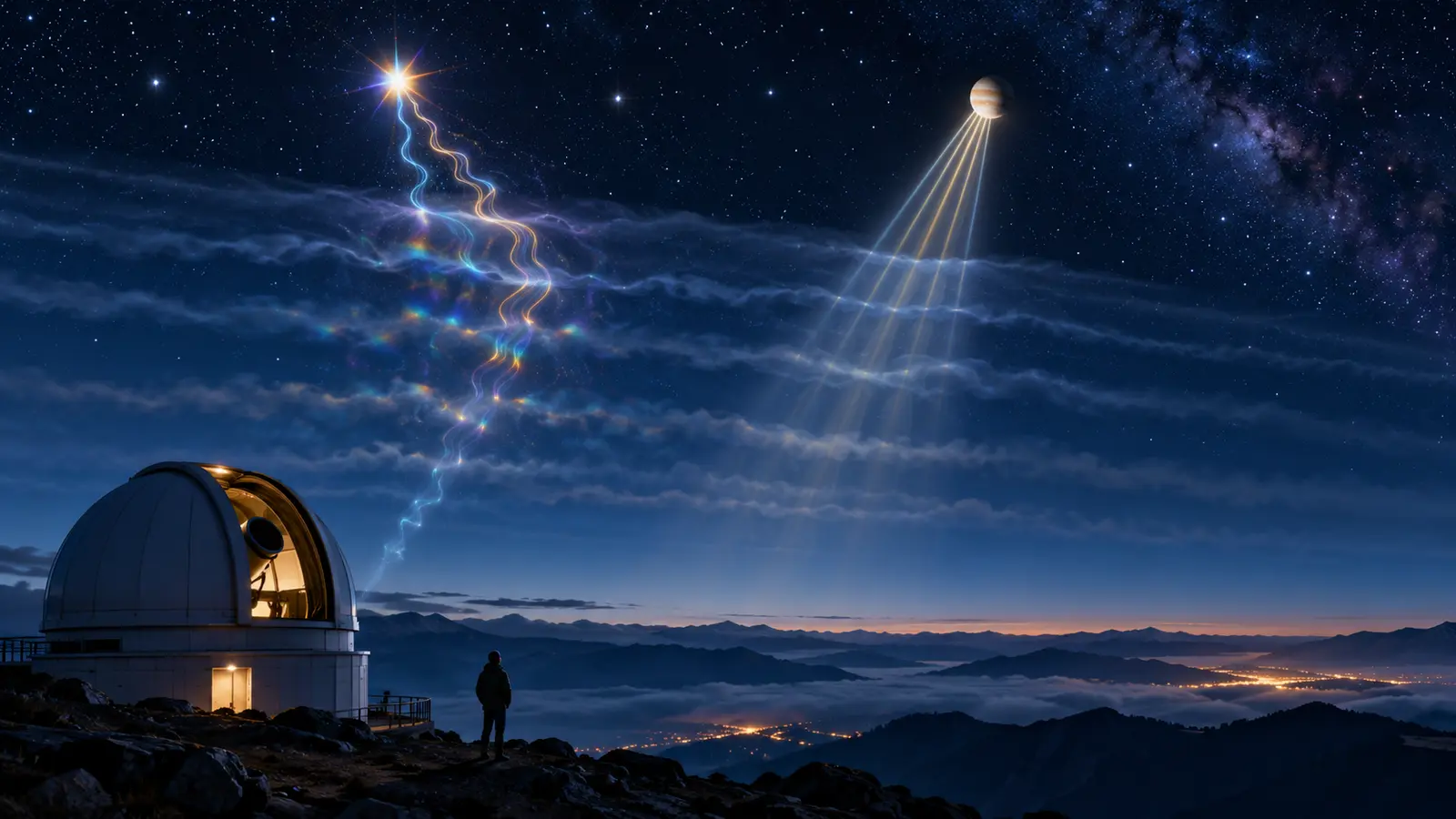
Look up on a clear night and the stars seem alive, changing brightness and position. A bright planet may look calmer. The difference usually comes from neither object: it is produced by the moving air above you. [1]
A point of light meets moving air
A star is so distant that it reaches the eye as an almost point-like source. As its light crosses turbulent pockets of air with different temperatures and densities, repeated refraction nudges that tiny image around. Your vision registers the rapid motion and brightness changes as twinkling. A planet has a small but measurable disk. Its light arrives through many neighboring atmospheric paths, so one distorted patch tends to average against another, making the planet appear steadier. [1]
Astronomers try to undo the sparkle
For astronomers, the same beautiful flicker is image blur called atmospheric seeing. Ground-based observatories fight it with adaptive optics: computers measure the distortion and command flexible mirrors to change shape in real time. When a convenient reference star is absent, a laser can create an artificial guide star high in the atmosphere. [2] Above the atmosphere, stars do not show this atmospheric twinkle at all. [3]
What to keep in mind
The explanation describes the usual naked-eye appearance; it does not make every steady point a planet. Turbulence varies, and cameras and telescopes record atmospheric blur differently from the eye. [1]
Sources & context
Numbered references link the explanation to its sources. Hypothetical examples and visual metaphors are labelled in the text. Checked 16 October 2026.
- NASA Goddard Space Flight Center — Why do stars appear to twinkle while planets do not?
- European Southern Observatory — Adaptive Optics
- European Space Agency — Starstruck (29 August 2022)
KEEP EXPLORING
 How One Galaxy Can Appear Several TimesExplore · 3 min read
 Heavy Methanol Exposes a Gap in Space ChemistryNewsroom · 1 min read
 The Dark Sky Is a Cosmic CluePeek · 1 min read
CURIOUS MINDS, SHARED IDEAS
Join the conversation
What surprised you? Share a thought or a question.
Loading reader responses…