
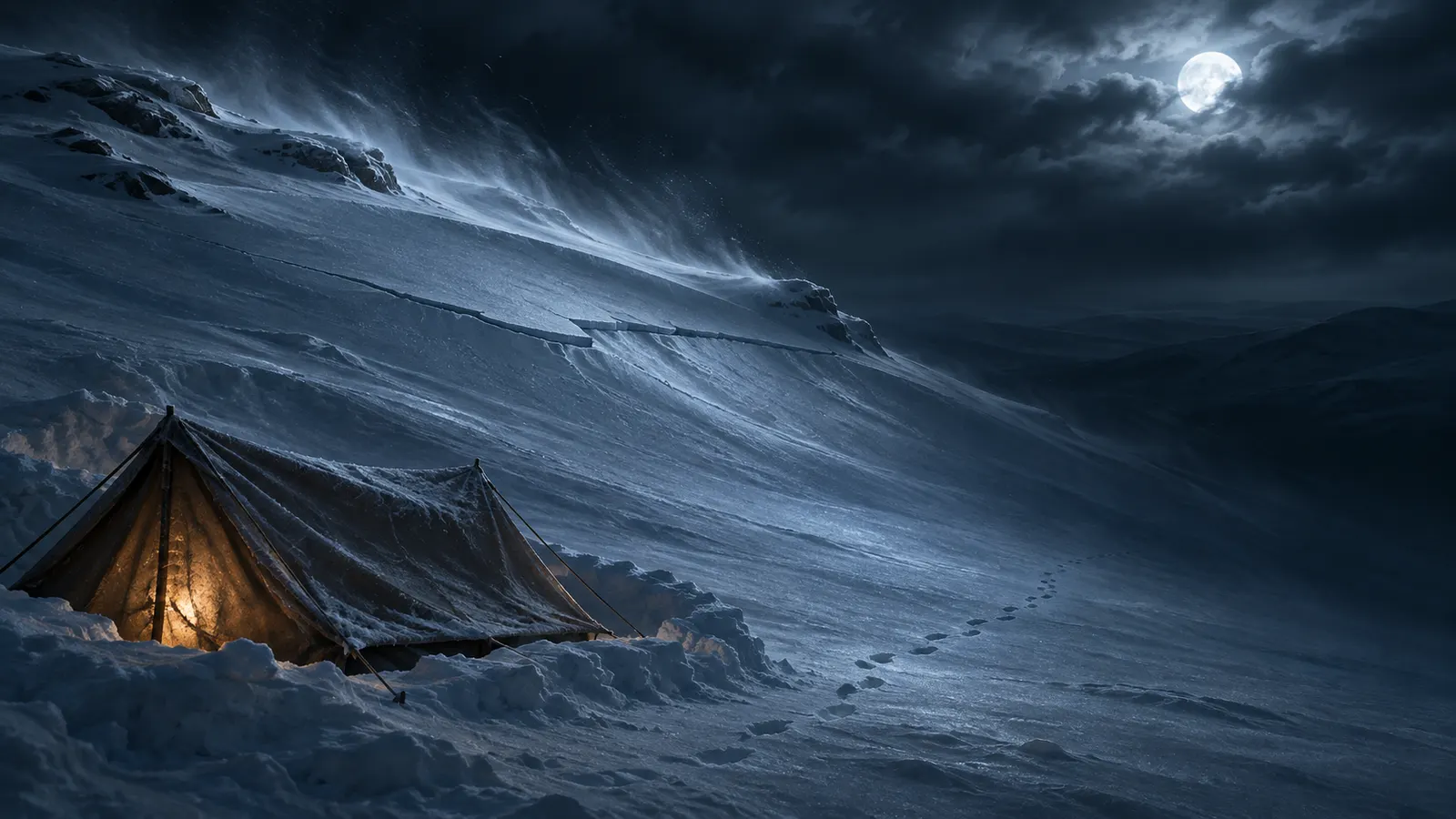
Nine experienced hikers left their tent on a freezing night in 1959 and never returned. The torn shelter, scattered bodies and severe injuries inspired decades of speculation. A modern avalanche model explains more than the sensational theories—but it still cannot replay the night. [1][2]
A camp abandoned in the dark
Ten hikers set out across the northern Ural Mountains in January 1959. One, Yuri Yudin, turned back because he was unwell. When the remaining nine missed their return date, searchers found their damaged tent on 26 February. Equipment and clothing remained inside. Bodies were later recovered between the tent and a cedar tree, and from a snow-filled ravine; several victims had major chest or skull injuries. With no survivor, the sequence of decisions was lost. [1]
Why an avalanche looked wrong
An avalanche was an early possibility, but the scene seemed to argue against it. Rescuers reported no obvious debris around the tent. The visible slope appeared shallower than the angle normally associated with releases. A slab would also need to explain why it released hours after the hikers cut a platform into the snow, and how snow could cause serious injuries without simply burying everyone. Those gaps helped military tests, attacks and other dramatic stories flourish. [1][2]
A delayed slab
In 2021, avalanche researcher Johan Gaume and geotechnical engineer Alexander Puzrin tested a narrower idea. Their peer-reviewed model combined a buried weak snow layer, irregular terrain, the cut made for the tent and wind transporting additional snow above it. Under those assumptions, the extra load could build slowly until a compact slab released several hours later. Their impact simulations showed that a relatively small block of dense snow could produce injuries consistent with the documented trauma. [2]
What later expeditions added
The model did not prove that an avalanche struck in 1959. It did, however, generate claims that could be checked on site. Follow-up expeditions and drone mapping found locally steep terrain and documented slab avalanches in the wider Dyatlov Pass area. ETH Zurich reported that the region is avalanche-prone and that nearby slopes can be steep enough for releases. That weakens two objections: that the landscape was too gentle and that avalanches did not occur there. [3]
A trigger is not the whole story
Even if a slab damaged the tent, the later deaths require another chain of events: evacuation into darkness, extreme cold, separation and failed attempts to find shelter or return. The model offers a credible trigger, not a minute-by-minute account. It also leaves open why the group made particular choices once outside. Dyatlov Pass is therefore less a contest between one neat answer and fantasy than a case where physics can narrow the possibilities without recovering the missing human decisions.
What to keep in mind
The avalanche mechanism is supported by models, terrain measurements and later observations, but no direct record confirms a slab at the tent in 1959. Later avalanches show possibility, not identity. Injury simulations depend on reconstructed snow and impact conditions, and the researchers themselves describe the scenario as plausible rather than proven.
Sources & context
Numbered references link the explanation to its sources. Hypothetical examples and visual metaphors are labelled in the text. Checked 12 November 2026.
- Using science to explore a 60-year-old Russian mystery
- Mechanisms of slab avalanche release and impact in the Dyatlov Pass incident in 1959
- The Dyatlov Pass mystery and what a research article can trigger
KEEP EXPLORING
 Can Light Turn Stored Heat Back Into Electricity?Explore · 3 min read
 A Martian Rock Can Remember More Than One Kind of WaterNewsroom · 3 min read
 Some Hessdalen Lights Appeared on RadarPeek · 1 min read
CURIOUS MINDS, SHARED IDEAS
Join the conversation
What surprised you? Share a thought or a question.
Loading reader responses…