
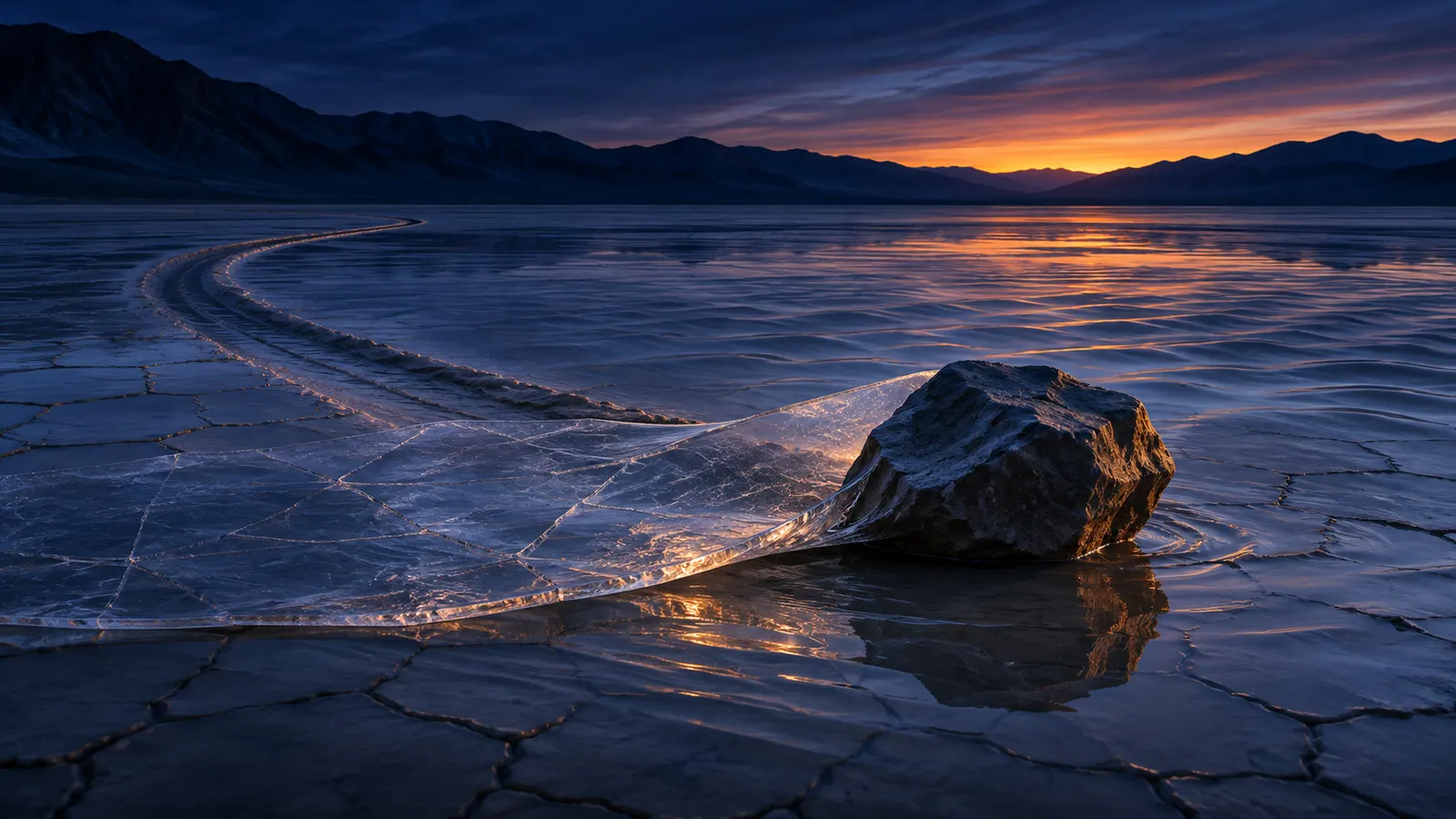
For decades, rocks at Death Valley’s Racetrack Playa seemed to travel across a dry lakebed by themselves, carving long trails into the mud. Some remained still for years, and nobody had directly measured them moving. [1][2]
The missing sequence
Researchers fitted test rocks with GPS loggers, installed a weather station and used time-lapse cameras. In winter 2013–2014, they recorded the missing sequence: shallow water froze overnight; morning sun fractured the ice; then light winds pushed floating panels against rocks on saturated mud. [1]
The ice was only about 3–6 millimetres thick. It did not lift the stones. Large panels acted like slow bulldozers, moving rocks at roughly 2–5 metres per minute. One instrumented rock travelled 224 metres across several events. [1]
Why nobody saw it
The stones looked supernatural partly because the mechanism was quiet, slow and rare. The trails formed beneath muddy water and ice, then appeared after wind moved the water away. [1]
What to keep in mind
The observations explain the documented events, not every trail or the movement of the largest stones. They also depended on an unusual combination of water, freezing nights, sunlight and steady wind. [1]
Sources & context
Numbered references link the explanation to its sources. Hypothetical examples and visual metaphors are labelled in the text. Checked 24 November 2026.
- [1] Norris et al. — Sliding Rocks on Racetrack Playa: First Observation of Rocks in Motion, PLOS ONE (27 August 2014)
- [2] U.S. National Park Service — Death Valley’s Moving Rocks
KEEP EXPLORING
 Why Do Some Booms Have No Visible Source?Explore · 3 min read
 Your Inner Ear Keeps Spinning After You StopPeek · 1 min read
 A Martian Rock Can Remember More Than One Kind of WaterNewsroom · 3 min read
CURIOUS MINDS, SHARED IDEAS
Join the conversation
What surprised you? Share a thought or a question.
Loading reader responses…