
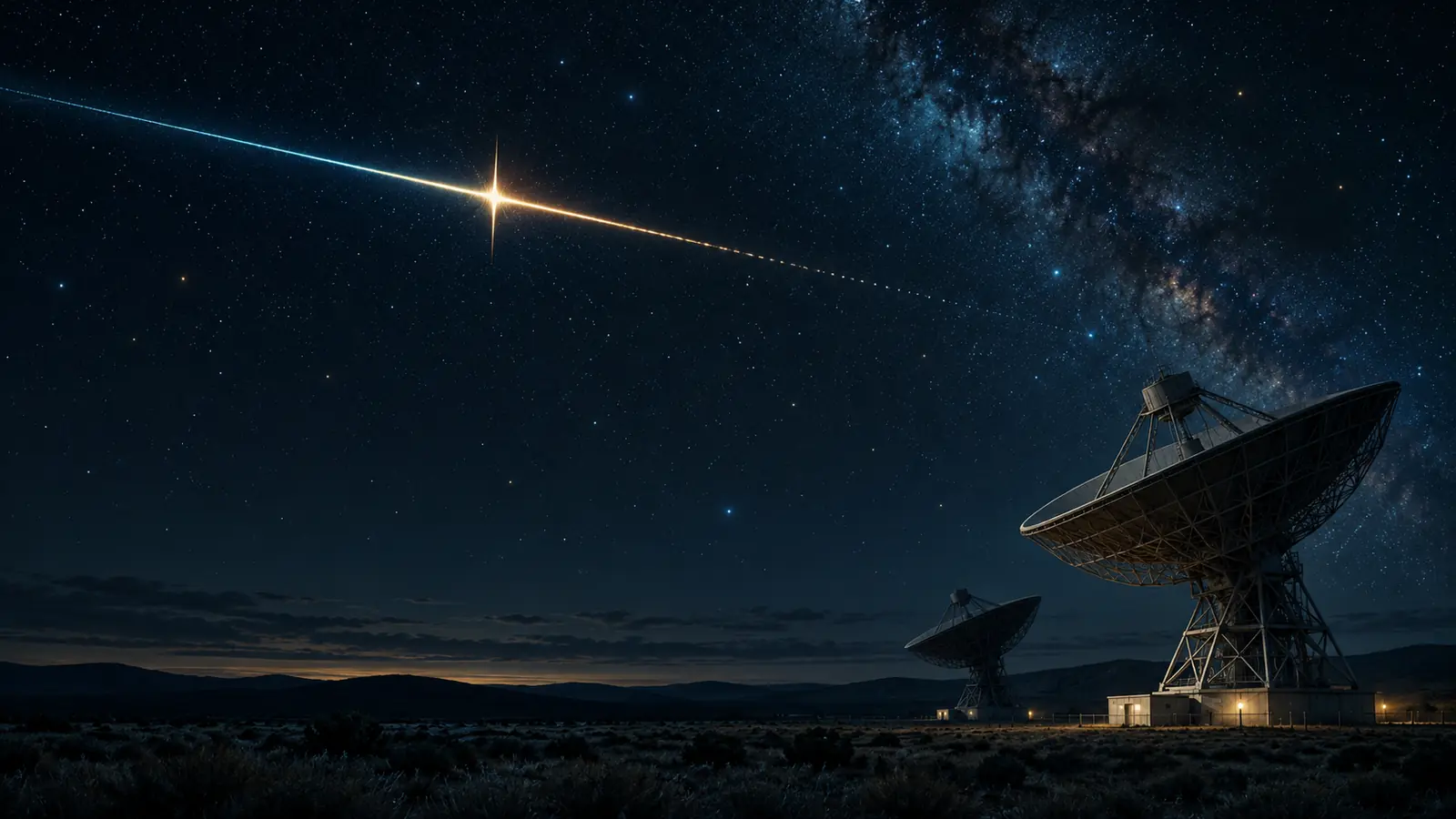
On 15 August 1977, a radio telescope in Ohio recorded one extraordinarily strong, narrow signal from the sky. It behaved enough like a distant source to become famous—and disappeared quickly enough to resist every confident explanation. [1][2]
The telescope set the clock
The Ohio State University’s Big Ear was not steering toward a target. Earth’s rotation carried strips of sky through its fixed observing beam. The mysterious signal climbed and fell across six roughly 12-second measurements, matching the bell-shaped response expected as a compact source crossed the beam. That makes “72 seconds” partly a property of the telescope: the source may have existed for exactly that long, much longer, or only while the beam could see it. [1][2]
The famous code was not a message
Volunteer astronomer Jerry Ehman found the sequence “6EQUJ5” on a printout days later and wrote “Wow!” beside it. The characters were not a message. They encoded increasing and then decreasing signal-to-noise levels, peaking around 30 times the background noise. The observation sat near 1420 megahertz, the natural radio line of neutral hydrogen—a scientifically interesting, internationally protected region of the spectrum. [1][2]
One beam heard it
Big Ear used two feed horns that should have viewed the same fixed celestial source several minutes apart. Yet only one detection was recorded, and the system could not determine which horn received it. That left two possible sky positions and a deeper puzzle: either the signal switched off before the second beam arrived, changed frequency, or was not a steady source at all. [1][3]
Interesting is not the same as artificial
Several features discourage an easy dismissal. The rise and fall resembled the telescope’s beam pattern rather than an ordinary stationary ground transmitter. Checks found no known satellite or spacecraft in the beam, and the frequency band was not meant for terrestrial or satellite transmission. None of that proves an extraterrestrial transmitter: unusual interference, reflected radio energy, or a transient natural process remain possible categories. [1][2]
Silence is evidence—but not an answer
The decisive test would be repetition. Later observations have not recovered the signal. A peer-reviewed search spent sessions of up to 14 hours on the reported coordinates without finding a similar event; a 2022 Breakthrough Listen search using Green Bank and the Allen Telescope Array also found no technosignature candidate. Those null results rule out some frequently repeating sources, but not a rare burst, a drifting frequency, or an event that never recurs. [3][4]
What to keep in mind
The surviving evidence is a coarse printout: signal intensity in 10-kilohertz channels averaged over ten-second integrations. Big Ear did not identify which feed horn received the event, so the sky position is ambiguous. Every explanation must fit one brief observation. “Unsolved” means insufficient evidence—not evidence for aliens. [1][3]
Sources & context
Numbered references link the explanation to its sources. Hypothetical examples and visual metaphors are labelled in the text. Checked 12 October 2026.
- Primary technical account: Jerry R. Ehman, Ohio State University Radio Observatory — The Big Ear Wow! Signal: What We Know and Don’t Know After 20 Years (revised 3 February 1998)
- SETI Institute — The Wow! Signal
- Peer-reviewed follow-up: Gray & Ellingsen — A Search for Periodic Emissions at the Wow Locale, The Astrophysical Journal 578 (2002)
- Breakthrough Listen — Search for the Wow! Signal (2022 observations)
KEEP EXPLORING
 Your Skeleton Repairs Itself by Taking It ApartPeek · 1 min read
 How One Galaxy Can Appear Several TimesExplore · 3 min read
 Helping Cells Read Past a Premature Stop SignalNewsroom · 1 min read
CURIOUS MINDS, SHARED IDEAS
Join the conversation
What surprised you? Share a thought or a question.
Loading reader responses…