
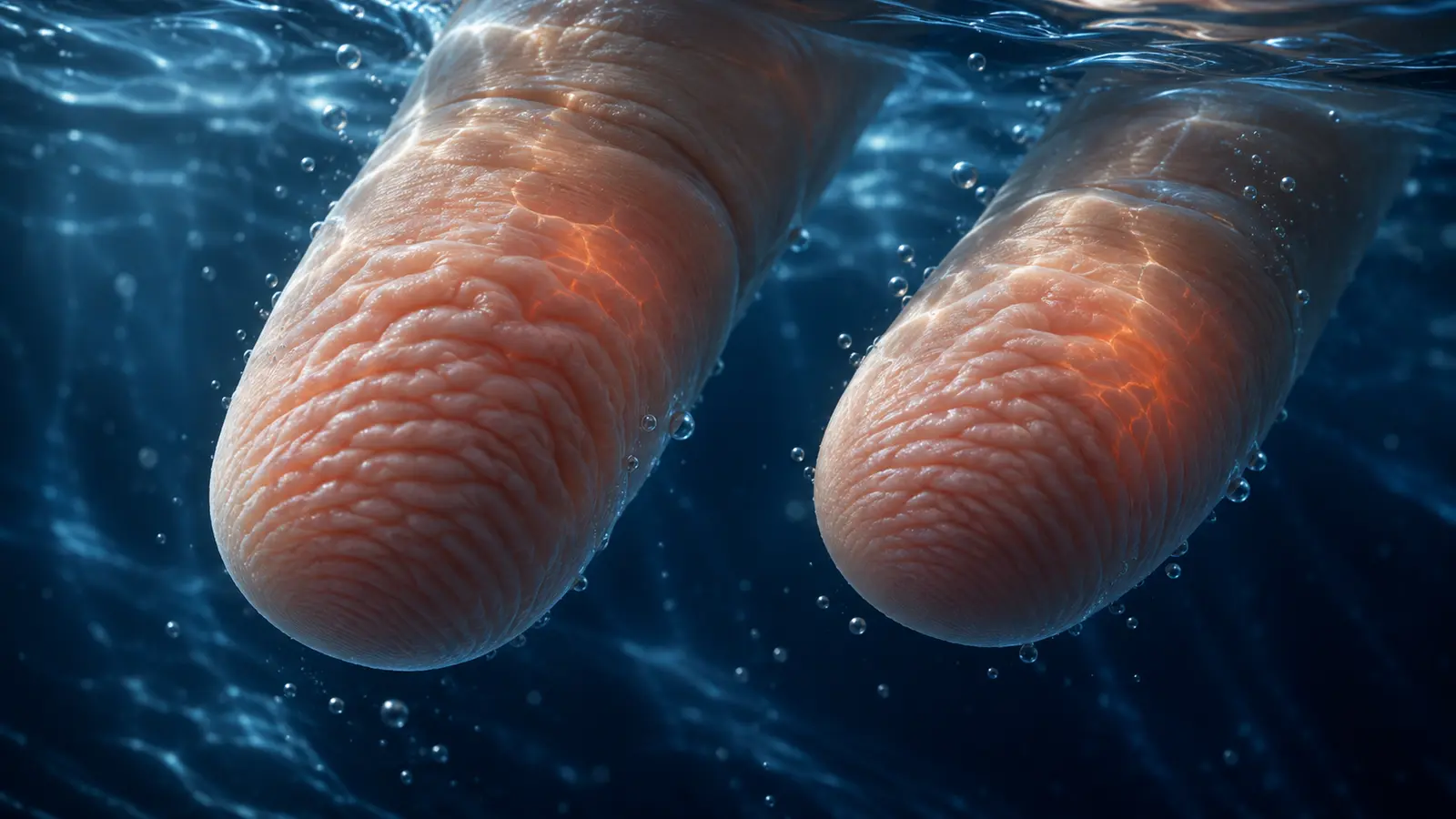
Leave your hands in water and fingertip ridges deepen. It looks as if the skin simply swells, but measurements point to an active response: blood vessels inside the fingertips narrow while the overlying skin folds. [1]
The change starts underneath
In a 2003 study, wrinkling arrived with a significant fall in blood-flow velocity, strongest in the small digital vessels. The authors concluded that vasoconstriction reduces the volume of the fingertip pulp. Because the surface skin has more area than the shrunken tissue beneath it, it buckles into valleys and ridges. [1]
That nervous-system control explains an older clinical clue: fingers with interrupted sympathetic innervation may wrinkle less or not normally after immersion. Water is the trigger, but intact nerve signalling helps create the shape. [1][3]
Useful tread or side effect?
Why do it? One experiment found that volunteers moved submerged objects faster with wrinkled fingers, supporting the idea that grooves help in wet conditions. [2] But a larger follow-up with 40 participants did not reproduce a wet-object dexterity advantage and found no change in measured touch sensitivity. [3]
What to keep in mind
Wrinkling varies with conditions and people, and these laboratory studies tested specific tasks. They establish the active vascular mechanism more strongly than they establish an evolutionary purpose. [1][2][3]
Sources & context
Numbered references link the explanation to its sources. Hypothetical examples and visual metaphors are labelled in the text. Checked 9 October 2026.
- Wilder-Smith & Chow — Water-immersion wrinkling is due to vasoconstriction (2003)
- Kareklas, Nettle & Smulders — Water-induced finger wrinkles improve handling of wet objects (2013)
- Haseleu et al. — Water-Induced Finger Wrinkles Do Not Affect Touch Acuity or Dexterity in Handling Wet Objects (2014)
KEEP EXPLORING
 Can a City Save Summer Heat for Winter?Explore · 4 min read
 Water Near a Black Hole Does Not Mean an OceanPeek · 1 min read
 A Martian Rock Can Remember More Than One Kind of WaterNewsroom · 3 min read
CURIOUS MINDS, SHARED IDEAS
Join the conversation
What surprised you? Share a thought or a question.
Loading reader responses…