
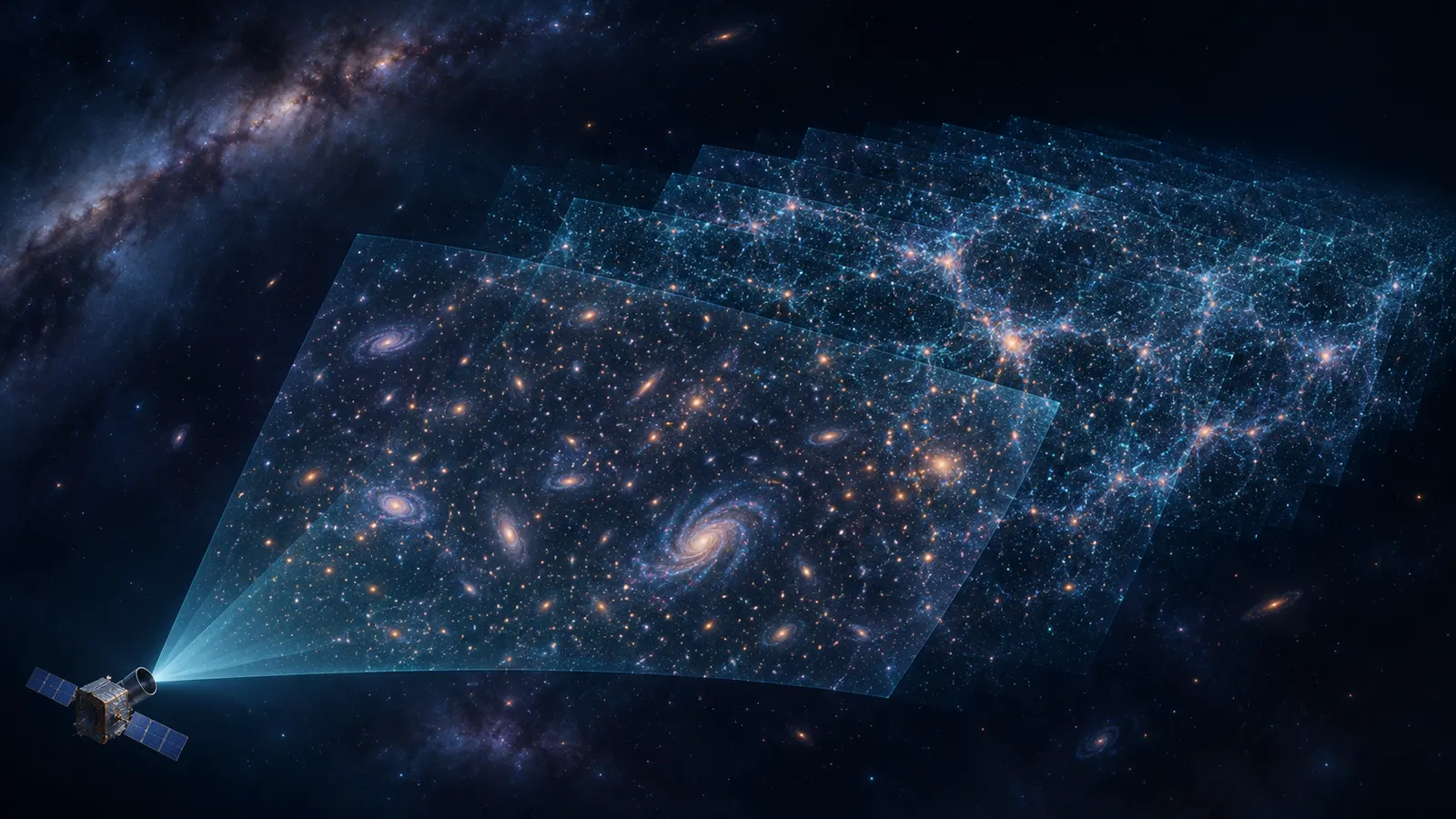
On 12 November, ESA and the Euclid Consortium opened a cosmic archive so large that its catalogues contain about a billion objects.
A survey becomes a shared laboratory
DR1-Foundation packages roughly 13 months of Euclid observations as calibrated images, spectra and catalogues covering more than 2,000 square degrees. Its overview paper reports about a billion catalogued objects, mainly from 1,975 square degrees of the Wide Survey and 77 square degrees of Deep Fields [1][2].
The map is not finished
This release lets researchers search enormous, consistently processed samples for rare lenses, galaxies and other targets. But it is the foundation, not Euclid’s completed 3D dark-Universe map: shear measurements, higher-level cosmology products and the complete DR1 are planned for mid-2027 [1][2]. The overview is an arXiv preprint submitted to Astronomy & Astrophysics, so it has not yet completed peer review.
What to keep in mind
What to keep in mind: catalogue size is not the same as confirmed discoveries. Candidate classifications and inferred distances still require validation, and the first release omits key weak-lensing products.
Sources & context
Numbered references link the explanation to its sources. Hypothetical examples and visual metaphors are labelled in the text. Checked 14 November 2026.
- [1] ESA — Euclid lays the foundation for its best-ever 3D map of the Universe (12 November 2026)
- [2] Euclid Collaboration — Euclid First Data Release 1 (DR1): Data release overview, arXiv:2611.16510 (submitted to Astronomy & Astrophysics; 12 November 2026)
KEEP EXPLORING
 Bright Cosmic Sources Were Hiding at the Softest EnergiesNewsroom · 1 min read
 Why One Radio Signal Still Refuses to Explain ItselfExplore · 3 min read
 Teaching Yeast to Use a Mixed Sugar MenuPeek · 1 min read
CURIOUS MINDS, SHARED IDEAS
Join the conversation
What surprised you? Share a thought or a question.
Loading reader responses…