
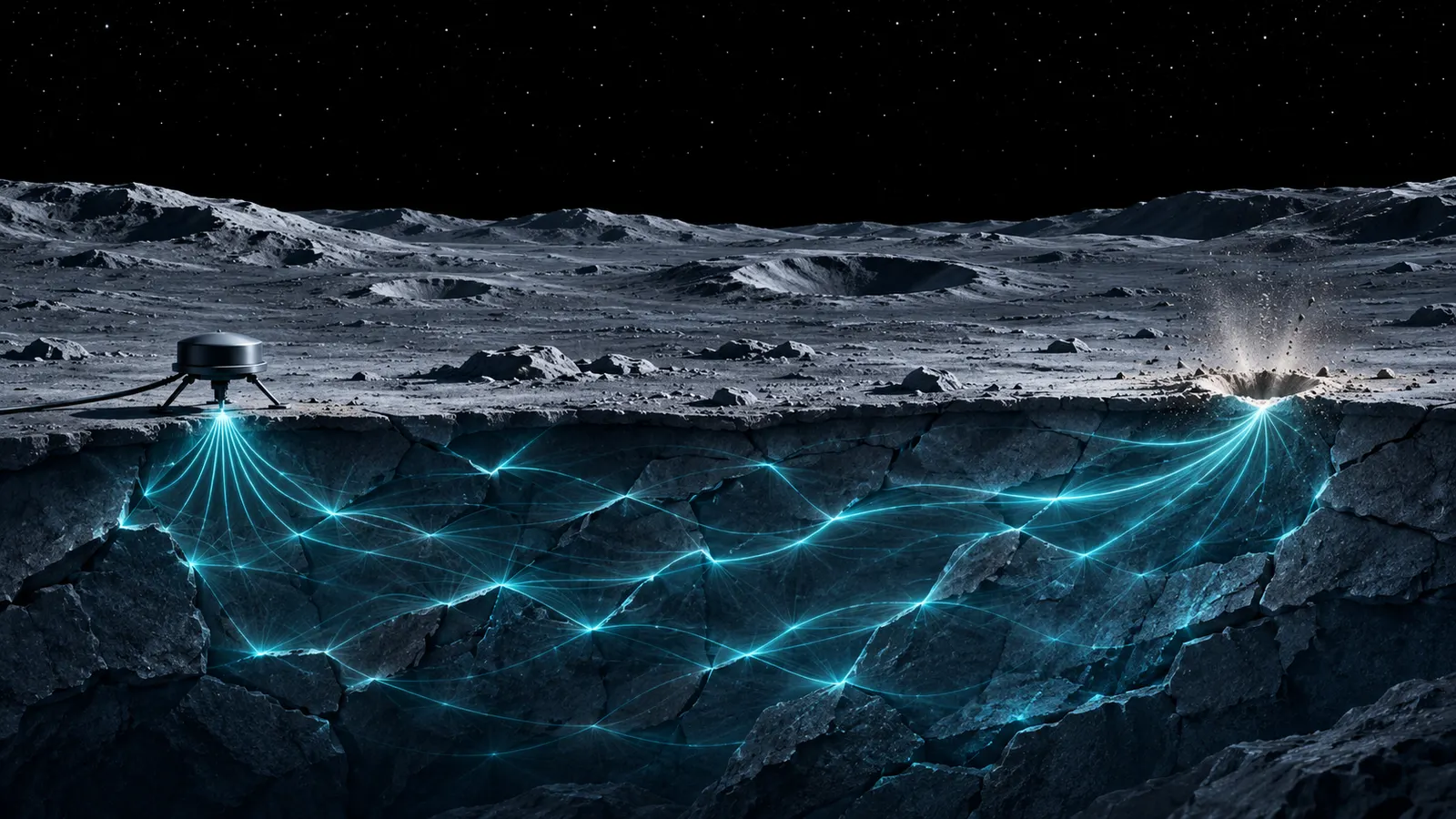
A quake on Earth usually fades quickly. On the Moon, the seismic signal can reverberate for far longer—sometimes for hours—not because the Moon is hollow, but because its crust handles vibrations very differently. [1][2]
Apollo heard a long coda
Apollo astronauts placed a four-station seismic network on the lunar nearside. From 1969 to 1977, it recorded thousands of natural moonquakes, meteoroid strikes and deliberate spacecraft impacts. [1] Some of the strongest impact signals decayed over several hours, while shallow moonquakes could continue for more than ten minutes. [1][2]
Broken rock redirects the waves
The upper lunar crust has been shattered by billions of years of impacts. In this fractured “megaregolith,” seismic waves scatter along many paths instead of travelling cleanly away from the source. The Moon’s extreme dryness also provides little damping, so the jumbled vibrations lose energy slowly. [2][3]
What to keep in mind
Duration depends on the event, depth, frequency and instrument. Apollo’s stations covered only the nearside and had limited sensitivity, so researchers still use new analysis methods—and need future lunar seismometers—to map the whole Moon accurately. [3][4]
Sources & context
Numbered references link the explanation to its sources. Hypothetical examples and visual metaphors are labelled in the text. Checked 27 November 2026.
- [1] NASA Science — NASA’s Apollo Samples, LRO Help Scientists Forecast Moonquakes
- [2] NASA Technical Reports Server — Towards Simulating a Realistic Planetary Seismic Wavefield: The Contribution of the Megaregolith and Low-Velocity Waveguides
- [3] Schmelzbach et al. — Locating Moonquakes With Single-Station Seismology, Geophysical Research Letters (2026)
- [4] NASA Science — Moon Composition and future lunar seismometers
KEEP EXPLORING
 Euclid Opened a Billion-Object Cosmic ArchiveNewsroom · 1 min read
 The Moon Is Taking a Little of Earth’s SpinPeek · 1 min read
 Could Moon Dust Become a Search for Ancient Technology?Newsroom · 3 min read
CURIOUS MINDS, SHARED IDEAS
Join the conversation
What surprised you? Share a thought or a question.
Loading reader responses…