
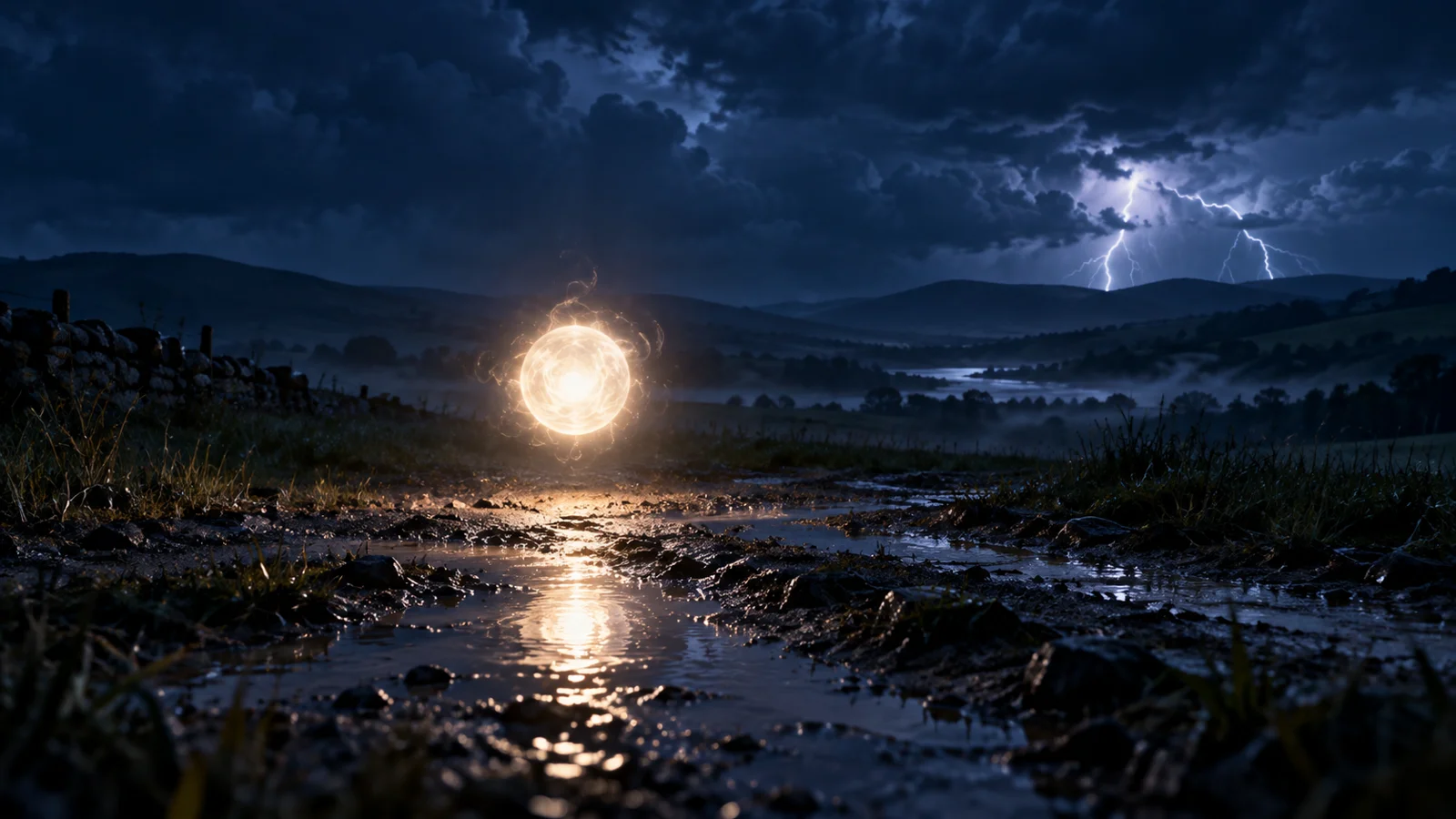
A glowing sphere after a storm sounds like science fiction. The difficult scientific question begins before choosing a theory: what exactly was observed?
Start with the event
Ball lightning is the label used for reports of unusual luminous balls, often associated with thunderstorms. Its reported appearance has inspired physical explanations, but a label does not guarantee that every similar-looking event has the same cause. The evidence has to connect a particular observation with measurements that competing explanations can be tested against. [1]
That makes this an unusual mystery: investigators need both a mechanism and a reliable way to recognize the thing the mechanism is supposed to explain. An attractive photograph alone cannot supply both.
A spectrum adds something a photograph cannot
In 2014, researchers reported optical and spectral measurements of a luminous event observed during a thunderstorm. The American Physical Society's account describes features associated with elements found in soil, including silicon, iron and calcium. These observations were consistent with a proposed explanation involving material from the ground. They were not a demonstration that all ball-lightning reports have been solved. [1]
A spectrum separates light into wavelengths. That lets researchers ask what is emitting, rather than only what outline a camera shows. The difference is powerful: resemblance suggests a question; a measured signature can constrain possible answers.
A convincing video can lead somewhere else
Research is still active. A February 2026 Texas State account describes Karl Stephan and Richard Sonnenfeld's investigation of security-camera footage recorded in Montana in 2023. The lights initially appeared promising. Reviewers instead considered an electrical arc near a powerline and burning fragments as a likely explanation. Camera blooming could help explain the apparently large glowing shapes. [2]
This is not a reason to dismiss every report. It is a reason to separate two claims: the camera recorded a bright event, and the event was ball lightning. The first can be true while the second remains unsupported. The investigation's value includes identifying an alternative that future reports should be checked against.
Can the laboratory help?
The University of Illinois McCall research group describes laboratory ball-plasma experiments intended to investigate properties relevant to the puzzle. A laboratory analogue gives researchers controlled conditions for asking how a luminous structure behaves. Similar appearance, however, does not by itself demonstrate that the experiment and a natural observation share a mechanism. [3]
A useful comparison must go beyond “they both glow.” It asks which measurable features match, which differ, and what would count against the proposed connection. The laboratory can narrow possibilities while leaving the natural event unresolved.
The next useful discovery
For a reader, the most revealing question is therefore not “Do you believe the sphere?” It is “What additional measurement would distinguish the explanations?” The spectrum, the camera's response and the environment each contribute a different constraint. [1][2]
That is what makes this a live research problem rather than a story with a missing final sentence. Better evidence can change both the explanation and the boundaries of the category being explained.
What to keep in mind
There is no demonstrated single mechanism covering every report. The Montana recording is not treated here as confirmed ball lightning. Laboratory analogues are not proof of the cause of natural events. No hazardous experiments should be attempted from this article.
Sources & context
Numbered references link the explanation to its sources. Hypothetical examples and visual metaphors are labelled in the text. Checked 6 October 2026.
- American Physical Society: First Spectrum of Ball Lightning
- Texas State University: Continuing ball-lightning investigation, February 2026
- University of Illinois McCall research group: Ball Plasma
KEEP EXPLORING
 A Strange Light. A Missing Explanation.Peek · 2 min read
 The Invisible Matter We Still Can't IdentifyExplore · 3 min read
 Bright Cosmic Sources Were Hiding at the Softest EnergiesNewsroom · 1 min read
CURIOUS MINDS, SHARED IDEAS
Join the conversation
What surprised you? Share a thought or a question.
Loading reader responses…